
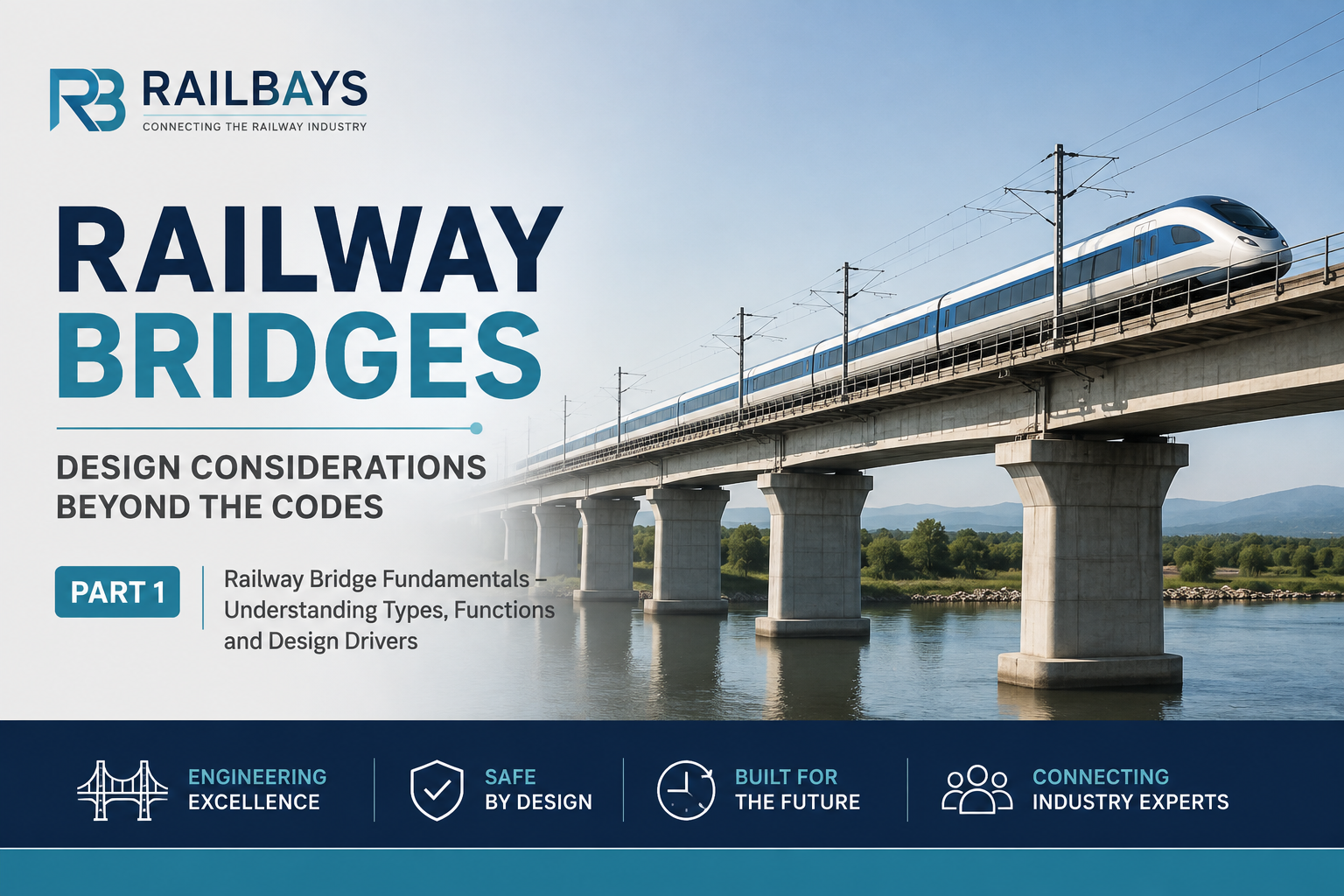
Part 1
Railway Bridge Fundamentals – Understanding Types, Functions and Design Drivers
Introduction
Railway bridges are among the most critical assets within any railway network. They provide safe and continuous passage across rivers, highways, valleys, existing rail corridors and other physical obstacles while carrying some of the highest repetitive loads experienced by civil infrastructure. Unlike highway bridges, railway bridges are subjected to concentrated axle loads, dynamic effects, vibration, braking and traction forces, thermal movements, and increasingly demanding operational requirements associated with higher train speeds and heavier freight traffic.
The design of a railway bridge extends well beyond satisfying structural code requirements. Every bridge must achieve a careful balance between structural performance, operational safety, constructability, durability, maintenance, environmental constraints and whole-life cost. Decisions made during the early stages of design often influence maintenance requirements and operational performance for more than a century.
This article is the first in the RailBays series on railway bridge engineering. It introduces the fundamental bridge types commonly used on railway projects and examines the principal design considerations that influence bridge selection. Later articles will explore loading, track-structure interaction, durability, maintenance and emerging technologies in greater depth.
Why Railway Bridges are Different
Although highway and railway bridges share many structural principles, railway structures operate under significantly different loading conditions.
Railway vehicles generate highly concentrated axle loads that are repeatedly applied along fixed wheel paths throughout the bridge’s service life. High-speed operations introduce additional dynamic amplification, while freight railways may subject structures to exceptionally large cumulative fatigue demands over many decades.
In addition to vertical loading, railway bridges must safely resist:
- Dynamic train effects
- Braking and traction forces
- Centrifugal forces on curved alignments
- Longitudinal rail forces
- Thermal expansion and contraction
- Wind loading
- Seismic actions where applicable
- Derailment loading
- Fatigue from millions of train passages
Passenger comfort also becomes an important design criterion, particularly for high-speed railways where excessive bridge vibration may influence ride quality.
Primary Functions of a Railway Bridge
A railway bridge must achieve far more than simply supporting the track.
Its principal functions include:
- Safely carrying railway traffic.
- Maintaining precise track geometry.
- Providing adequate clearance for roads, waterways or other railways.
- Accommodating thermal movement.
- Limiting structural deflections.
- Providing long-term durability.
- Allowing safe inspection and maintenance.
- Minimising disruption during construction.
These functional requirements often govern bridge selection as much as structural efficiency.
Common Types of Railway Bridges
Beam Bridges
Beam bridges represent the simplest and most widely used bridge form for railway applications.
They are generally economical for short and medium spans and may be constructed using reinforced concrete, prestressed concrete or structural steel.
Typical span range:
- 10–40 metres
Advantages include:
- Simple construction
- Low maintenance
- Cost-effective
- Fast installation
Typical applications include highway crossings, small rivers and urban rail corridors.
Box Girder Bridges
Box girders provide excellent torsional stiffness and are particularly suitable for curved alignments and longer spans.
They may be constructed as reinforced concrete, prestressed concrete or steel composite sections.
Typical span range:
- 30–150 metres
Common applications include metro systems, high-speed rail and elevated viaducts.
Arch Bridges
Arch bridges efficiently transfer loads into compression, making them suitable where strong foundations exist.
Modern railway arch bridges are often constructed from reinforced concrete or steel.
Advantages include:
- Excellent durability
- Attractive appearance
- High structural efficiency
However, construction complexity and foundation requirements generally increase project costs.
Truss Bridges
Truss bridges remain popular for long railway spans where structural weight must be minimised.
Their triangulated members efficiently carry axial forces while providing excellent structural performance.
Typical applications include:
- Major river crossings
- Existing railway upgrades
- Heavy freight corridors
Cable-Stayed Bridges
Where exceptionally long spans are required, cable-stayed bridges often provide the most economical solution.
Railway cable-stayed bridges require significantly greater deck stiffness than highway bridges to control railway deflections and vibrations.
Typical span range:
- 200–800 metres
Suspension Bridges
Although common for highways, suspension bridges are relatively rare for railways because excessive flexibility can adversely affect railway operations.
Only a limited number of railway suspension bridges exist worldwide.
Factors Influencing Bridge Selection
Selecting an appropriate bridge type requires balancing numerous technical and project constraints.
Typical considerations include:
Operational requirements
- Passenger or freight railway
- Design speed
- Future capacity
- Electrification
Site constraints
- Geology
- Hydrology
- Existing infrastructure
- Utility conflicts
- Available construction access
Structural considerations
- Span length
- Foundation conditions
- Track alignment
- Dynamic behaviour
Construction considerations
- Possessions
- Temporary works
- Modular construction opportunities
- Launching methods
Whole-life considerations
- Inspection access
- Maintenance requirements
- Corrosion protection
- Future strengthening
Designing Beyond the Codes
Modern bridge design standards such as Eurocodes, AREMA and national railway standards provide the minimum technical requirements necessary to achieve safe structural performance.
However, successful railway bridges require engineers to consider a much broader range of issues that are often project-specific and not explicitly covered by design codes.
These include:
- Constructability
- Whole-life asset management
- Operational resilience
- Climate change adaptation
- Digital engineering
- Sustainability
- Carbon reduction
- Future network expansion
Experienced bridge engineers understand that meeting the code is only the starting point. The most successful railway bridges combine structural efficiency with practical construction methods, operational reliability and economical maintenance throughout their service life.
Looking Ahead
As railway networks continue to expand and train speeds increase, bridge engineering will continue to evolve through new materials, digital design tools, modular construction techniques and advanced structural monitoring systems.
The following articles in this series will explore these topics in greater depth, beginning with the complex loading mechanisms that distinguish railway bridges from other civil structures.
About This Series
Railway Bridges – Design Considerations Beyond the Codes is a RailBays technical series exploring the engineering principles, design challenges and practical considerations involved in delivering safe, durable and high-performing railway bridge infrastructure. Future articles will cover structural loading, track-structure interaction, durability, maintenance, construction methodologies and emerging technologies shaping the next generation of railway bridges.