Poland’s high-speed rail programme has reached another major construction milestone, with all components of the giant Tunnel Boring Machine (TBM) now delivered to Łódź for the construction of a new 4.6 km high-speed railway tunnel beneath the city.
The tunnel will form a key part of Poland’s planned high-speed rail network, providing a new underground rail connection through Łódź and supporting the future high-speed routes linking Warsaw, Łódź, Wrocław and Poznań.
Giant TBM being assembled underground
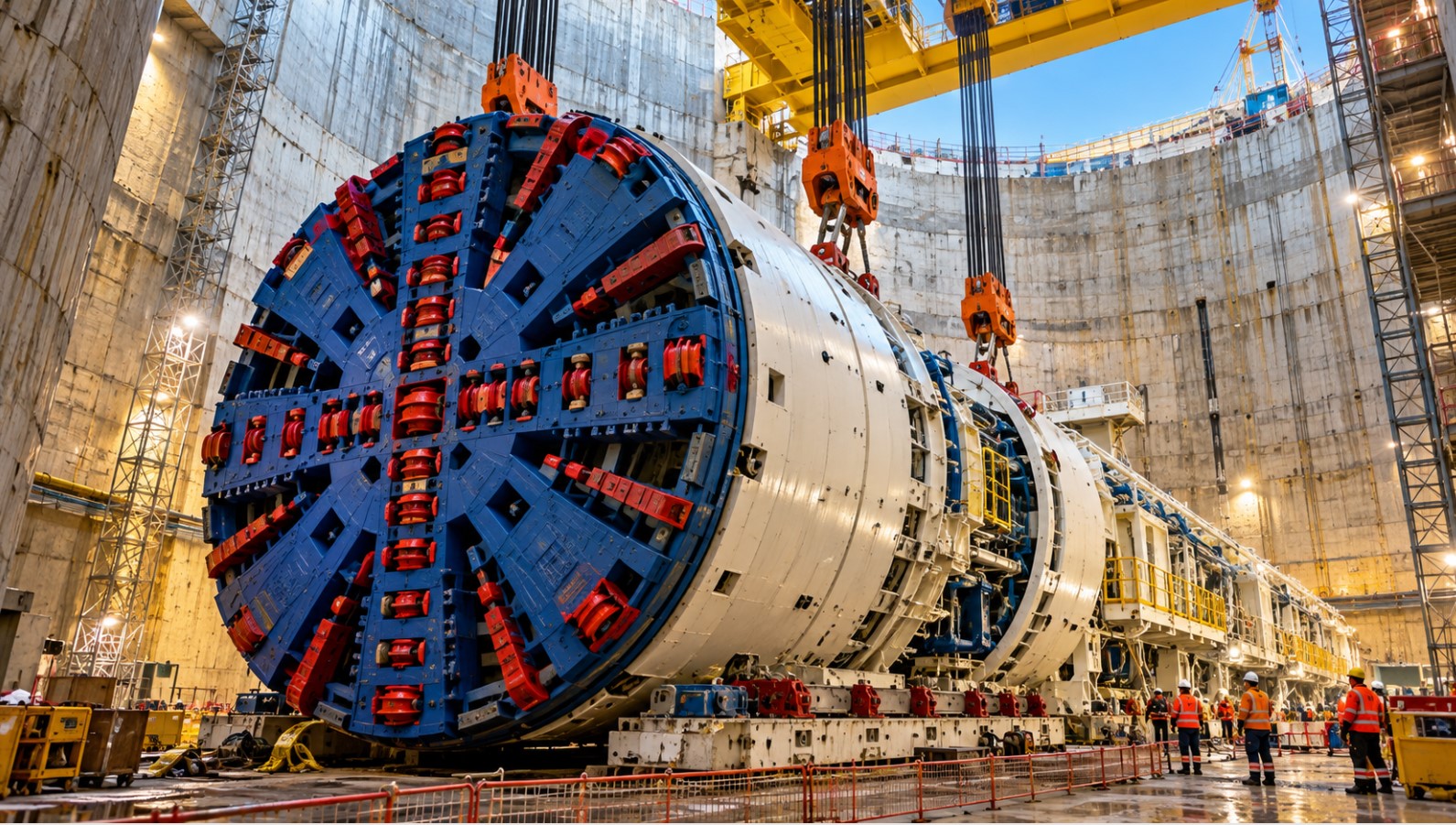
Assembly of the TBM is taking place within the Retkinia launch chamber, approximately 45 metres below ground level.
An earlier major construction milestone saw the first large TBM components lowered into the chamber. Two sections, each approximately 19 metres long and weighing around 215 tonnes, were lowered underground using a 450-tonne gantry crane.
The arrival of the remaining components means the project can now progress with the underground assembly of the complete machine.
Once assembled, the TBM will be approximately 130 metres long and weigh around 2,500 tonnes, making it one of the most significant pieces of specialist construction equipment deployed on Poland’s developing high-speed rail programme.
The assembled cutting head alone is expected to weigh approximately 420 tonnes.
Herrenknecht TBM for the Łódź tunnel
Key components of the TBM, including its main drive, were manufactured by German tunnelling equipment specialist Herrenknecht at its facility in Schwanau, Germany.
The final oversized deliveries to Łódź included the main drive and central section of the cutting head.
Contractor PORR is responsible for assembling the machine within the Retkinia launch chamber before tunnelling operations commence.
The TBM incorporates the equipment required for excavation and tunnel construction, including power supply, hydraulic, control and excavated-material transportation systems.
4.6 km tunnel beneath Łódź
The TBM will excavate approximately 4.6 km beneath Łódź, travelling from the Retkinia launch chamber towards a receiving chamber near the Łódź House of Culture.
The completed tunnel is expected to have an internal diameter of approximately 12.6 metres.
Construction presents a significant engineering challenge due to the tunnel’s urban location beneath an established city environment.
The tunnelling operation will therefore require careful management of ground conditions, settlement, existing buildings, utilities and other infrastructure along the alignment.
Part of Poland’s future high-speed rail network
The Łódź tunnel is an important component of Poland’s planned high-speed railway infrastructure.
The wider programme will establish new high-speed connections between Warsaw and Łódź, with the network subsequently branching towards Poznań and Wrocław.
The new infrastructure is intended to significantly improve east-west rail connectivity while integrating Łódź more closely into Poland’s national and international railway network.
The project is also linked with Poland’s wider development of new transport infrastructure associated with the planned central airport and national rail programme.
TBM launch targeted for 2027
Following completion of assembly and commissioning activities, the giant TBM is expected to begin its underground journey from Retkinia in 2027.
The start of boring will represent another major milestone for the Łódź high-speed railway tunnel and Poland’s broader high-speed rail programme.
With all major TBM components now on site, attention will turn to completing assembly, testing and commissioning of the machine ahead of excavation.
The project represents one of the most technically significant underground railway construction activities currently progressing in Poland.
RailBays will continue to follow the development of Poland’s high-speed rail programme and major construction milestones associated with the Łódź tunnel.
Related Railway News