

Why I Wrote This Article
Throughout my career as a railway professional, I have had the opportunity to work across different stages of the railway lifecycle ,from feasibility and design through construction, installation, testing, commissioning and handover. Working across these different phases has reinforced one important lesson for me: quality cannot be added to a railway at the end of the project. It has to be built into every stage of its development.
The quality of the final railway is influenced by how clearly requirements are defined, how thoroughly designs are reviewed and coordinated, how interfaces are managed, how materials and installations are controlled, how testing is undertaken, how defects and non-conformances are resolved, and how evidence is maintained through to final acceptance.
.I believe that when a railway project follows a well-structured Quality Management System (QMS) throughout its lifecycle, it significantly improves our ability to deliver a railway that is safe, reliable, maintainable and built to the required quality. This is why I wanted to write this short guide—not simply to explain ISO 9001, but to look at its principles from the practical perspective of railway project delivery and show how quality management connects the different stages of creating a railway
Quality is not just the responsibility of the Quality Team. Every engineer, designer, contractor, supplier, installer and tester contributes to the quality of the railway we ultimately hand over
.
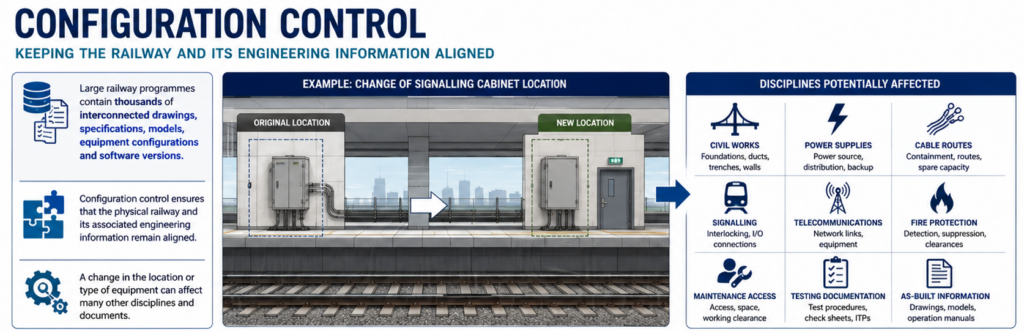
What is ISO 9001?
ISO 9001 is an internationally recognised standard for establishing, implementing, maintaining and continually improving a Quality Management System (QMS).
Published by the International Organization for Standardization (ISO), the standard provides a structured framework that helps organisations consistently deliver products and services that meet customer, contractual, statutory and regulatory requirements.
ISO 9001 is not specifically a railway standard. It can be applied to organisations of any size and across almost any industry. In the railway sector, however, its principles are particularly relevant because railway projects involve complex organisations, multiple engineering disciplines, extensive supply chains and thousands of requirements, documents, inspections and tests that must be systematically controlled.
ISO 9001 in a Railway Context
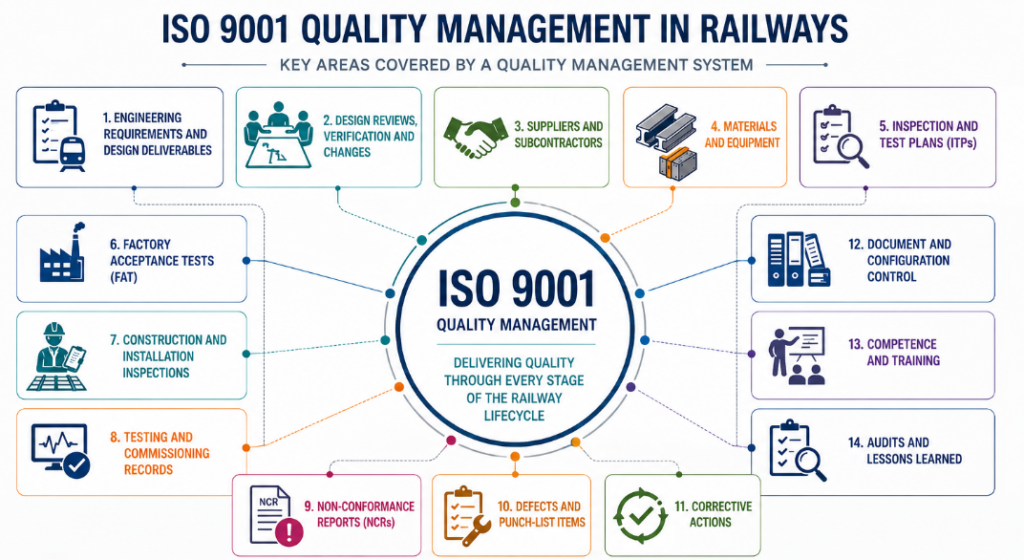
On a railway project, quality management extends far beyond checking the finished infrastructure or equipment.
The QMS provides the processes through which quality is managed throughout the project lifecycle:
Requirements → Design → Procurement → Manufacturing → Construction & Installation → Testing & Commissioning → Handover → Operations & Maintenance
Quality is More Than Inspection
An important principle to understand is that quality cannot simply be inspected into a railway system at the end of construction. If requirements are unclear, interfaces are poorly managed, designs are inadequately reviewed, suppliers are uncontrolled or installation records are incomplete, final inspection alone cannot provide effective quality assurance. ISO 9001 therefore promotes a process-based and risk-based approach, where quality is planned and controlled throughout delivery rather than relying solely on final inspection.
For railway projects, this means establishing evidence that the infrastructure and systems have been designed correctly, manufactured correctly, installed correctly, tested correctly and appropriately documented before acceptance.
RailBays Key Point: ISO 9001 does not tell engineers how to design a railway. It provides the management framework that helps ensure railway engineering and delivery processes are planned, controlled, verified, recorded and continually improved.
1 Why ISO 9001 Matters in Railways
Railway projects are among the most complex multidisciplinary infrastructure programmes. A railway is not simply a track and a train; it is an integrated system made up of civil infrastructure, stations, depots, rolling stock and numerous electrical, mechanical and digital systems that must ultimately operate together as one railway.
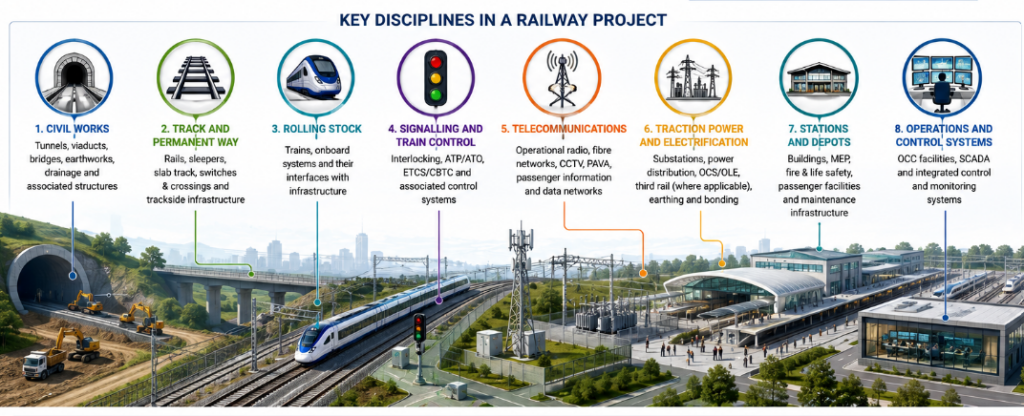
A typical railway programme may involve:
- Civil works – tunnels, viaducts, bridges, earthworks, drainage and associated structures.
- Track and permanent way – rails, sleepers, slab track, switches and crossings and trackside infrastructure.
- Rolling stock – trains, onboard systems and their interfaces with infrastructure.
- Signalling and train control – interlocking, ATP/ATO, ETCS/CBTC and associated control systems.
- Telecommunications – operational radio, fibre networks, CCTV, PAVA, passenger information and data networks.
- Traction power and electrification – substations, power distribution, OCS/OLE, third rail where applicable, and earthing and bonding.
- Stations and depots – buildings, MEP systems, fire and life safety systems, passenger facilities and maintenance infrastructure.
- Operations and control systems – OCC facilities, SCADA and integrated control and monitoring systems.
Each discipline can contain thousands of individual requirements, drawings, calculations, specifications, equipment items, inspections and test records.
ISO 9001 Across the Railway Lifecycle
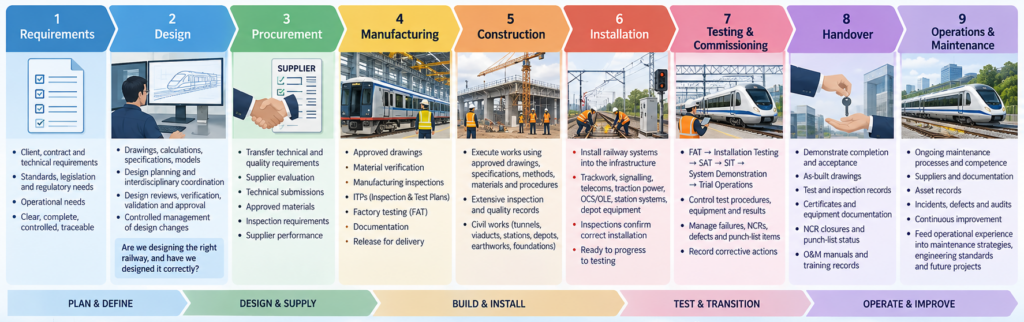
One of the most important concepts of ISO 9001 is that quality should be managed throughout the entire lifecycle of a product or service. For a railway project, this means quality management begins long before construction starts and continues beyond testing and handover into operation and maintenance.
A railway Quality Management System therefore needs to support the complete delivery chain:
Requirements → Design → Procurement → Manufacturing → Construction → Installation → Testing & Commissioning → Handover → Operations & Maintenance
2 Quality Planning on a Railway Project
Effective quality management begins with planning. On a railway project, it is not sufficient to inspect completed works and identify defects afterwards. The project should establish from the outset how quality will be achieved, controlled, verified, documented and continually improved throughout delivery.
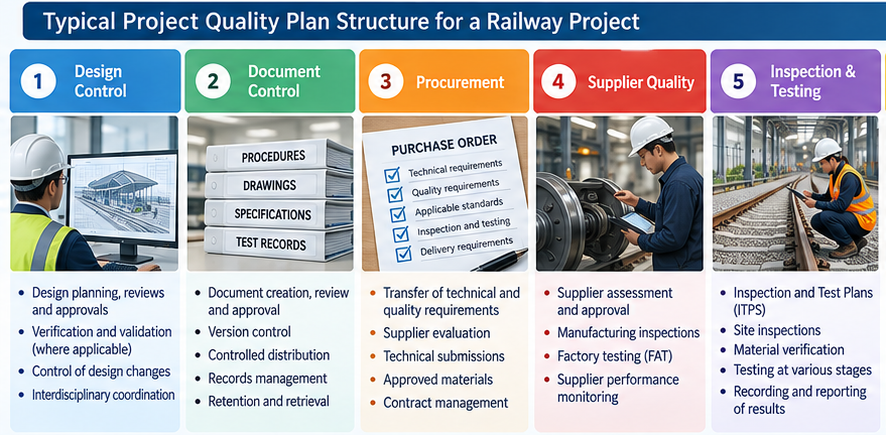
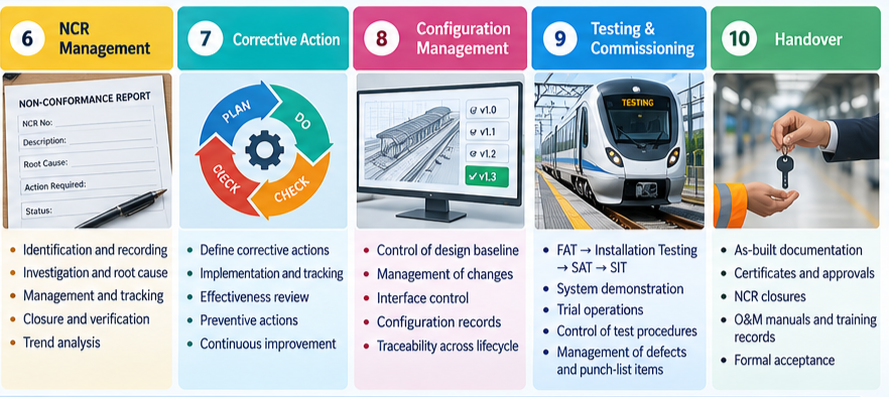
The Project Quality Plan (PQP) is normally the principal document describing how the organisation’s Quality Management System will be applied to a particular railway project.
2.1 Project Quality Plan
The Project Quality Plan translates the organisation’s overall QMS into project-specific arrangements.
Depending on the size and complexity of the railway programme, it may define:
3 Design Phase Quality Control
In railway projects, many quality problems that eventually appear during construction, installation or testing can originate much earlier during design. Effective design control therefore aims to identify errors, omissions, inconsistencies and interface conflicts before they reach the construction site or become embedded in railway systems. Under an ISO 9001 Quality Management System, design should be undertaken through a planned, controlled and traceable process from initial requirements through to approved design outputs. A simplified railway design process can be represented as:
Discipline Check → IDR / IDC → ICD Coordination → MDR / MDC → Verification → Gate Review → Approved Design
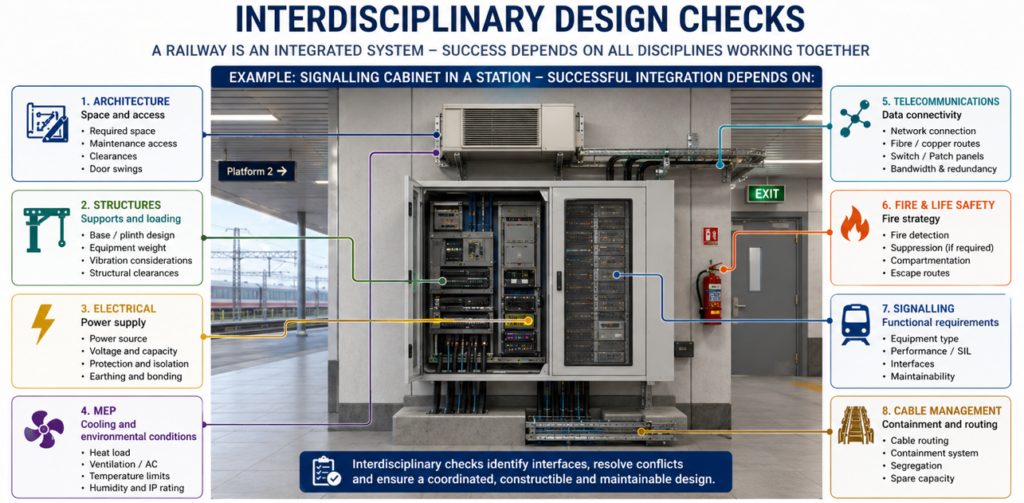
3.1 Inter-Disciplinary Design Reviews (IDR) / Integrated Design Checks (IDC)
An Inter-Disciplinary Design Review (IDR) or Integrated Design Check (IDC) is used to confirm that the design produced by one discipline has been properly coordinated with other affected disciplines.
3.2 Design Interface Control Documents (D- ICDs)
Railway projects contain numerous interfaces between civil infrastructure, railway systems, rolling stock, stations, depots, operations and external stakeholders. A Design Interface Control Document (D-ICD) provides a controlled mechanism for defining, coordinating, verifying and ultimately closing these interfaces during the design process.
A key part of developing a D-ICD is the timely exchange of information between the interfacing parties. Where one party requires technical information, design criteria, loads, dimensions, performance requirements or other inputs from another party, a Request for Information (RFI) can be raised to formally obtain and record the required information.
The RFI process therefore supports the development of the D-ICD by allowing interface requirements and assumptions to be progressively clarified before final agreement. Typical information exchanged through RFIs may include:
- design loads and structural reactions;
- equipment locations, dimensions and spatial requirements;
- embedded components and fixing requirements;
- electrical loads and power requirements;
- cable containment and routing requirements;
- clearances and access requirements;
- earthing and bonding requirements;
- environmental and operational criteria; and
- installation, testing and maintenance requirements.
A typical interface development process can therefore be represented as:
Identify Interface → Define Scope Boundary → Identify Required Inputs → Raise RFI → Interfacing Party Provides Requirements → Review & Coordinate → Incorporate into Design → Update D-ICD → Verify Interface → D-ICD Sign-Off
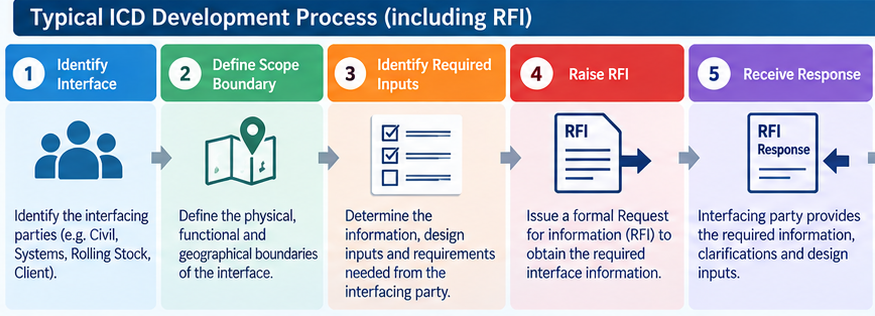
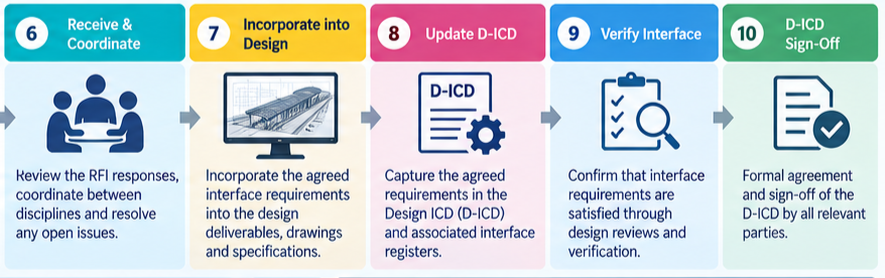
The objective is that critical interface requirements are obtained, coordinated and incorporated into the design before the D-ICD is formally signed off, rather than leaving unresolved assumptions to later stages of construction or installation.
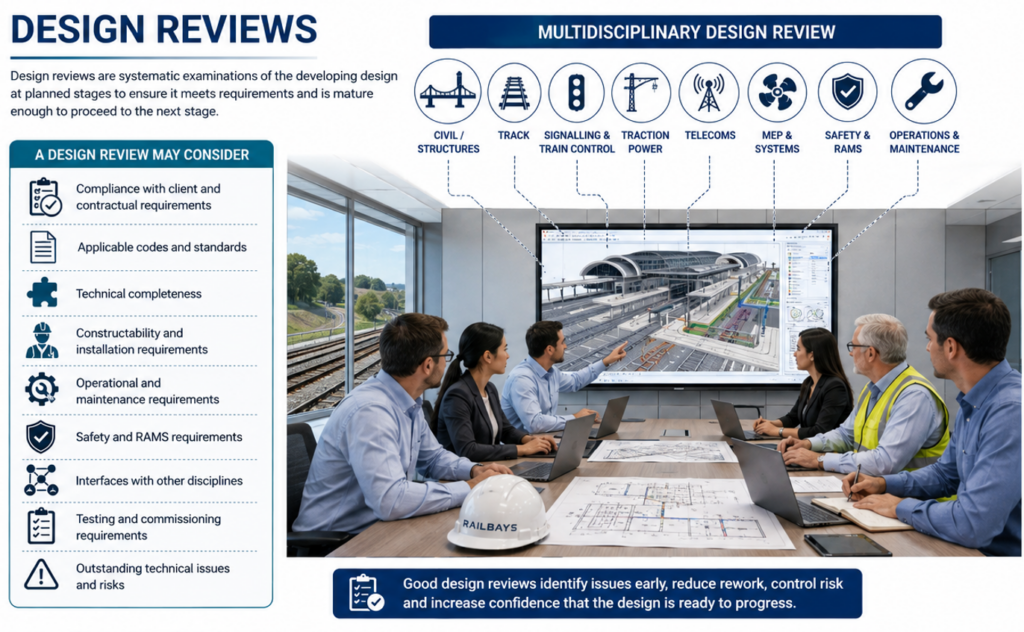
3.3 Multi-Disciplinary Design Reviews (MDR) / Multi-Disciplinary Checks (MDC)
While an IDR/IDC may focus on coordination between particular disciplines or design packages, a Multi-Disciplinary Design Review (MDR) or Multi-Disciplinary Check (MDC) provides a broader review of the combined design.
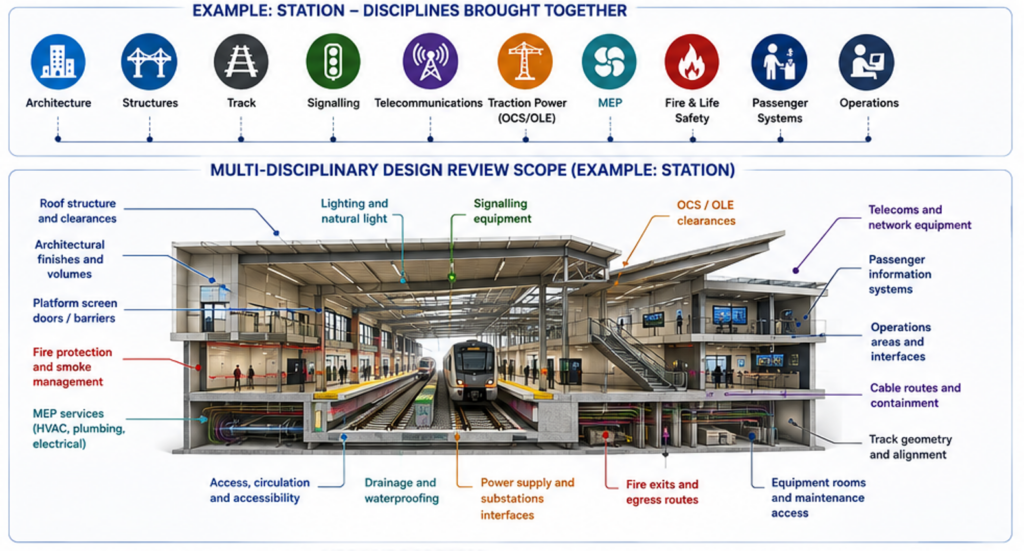
This is particularly valuable for highly integrated railway areas such as: Stations | Depots | Tunnels | Technical Buildings | OCC | Substations | Shafts | Trackside Systems
For a station, for example, the review may bring together architecture, structures, track, signalling, telecommunications, traction power, MEP, fire and life safety, passenger systems and operations.
The objective is to ask:
Does the complete multidisciplinary design work as an integrated railway facility?
3.4 Gate Reviews – Stage Gates / Design Gates
Gate Reviews provide formal decision points within the design lifecycle.
Rather than allowing design development to progress automatically, a project may establish defined gates at which the maturity and readiness of the design are assessed.
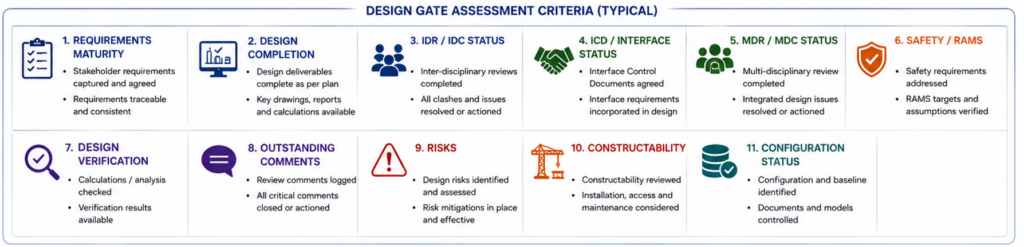
A typical progression could be: Design Development → Review → Gate Assessment → Actions/Closure → Approval to Proceed → Next Design Stage
A Design Gate may consider: Requirements maturity | Design completion | IDR/IDC status | ICD/interface status | MDR/MDC status | Safety/RAMS | Design verification | Outstanding comments | Risks | Constructability | Configuration status

3.5 Verification & Validation
Design verification asks an important question:
Have we designed it correctly?
Verification confirms that the design outputs satisfy the specified design inputs and requirements. Depending on the railway discipline, verification could involve independent calculations, drawing checks, technical reviews, simulations, model checks, interface reviews or other engineering assessments.
Verification should be appropriately documented so there is evidence of what was checked, by whom, when and with what outcome.4.6 Validation
Validation addresses a slightly different question:
Have we designed the right solution for its intended use?
A design can theoretically satisfy individual calculations and specifications while still failing to meet the intended operational need.For railway systems, validation may therefore involve simulations, prototypes, mock-ups, system testing, operational scenarios or ultimately testing of the completed system under representative conditions.
4 Construction and Installation Phase – Quality Control
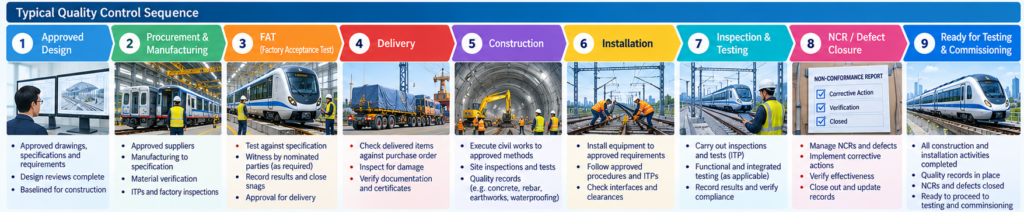
Once the railway design has been approved, quality management moves from controlling what is to be built toward demonstrating that equipment and infrastructure are manufactured, delivered, constructed and installed in accordance with approved requirements. For railway projects, this phase can involve civil works, track, signalling, telecommunications, traction power, OCS/OLE, station systems, depot equipment and many other specialist systems.
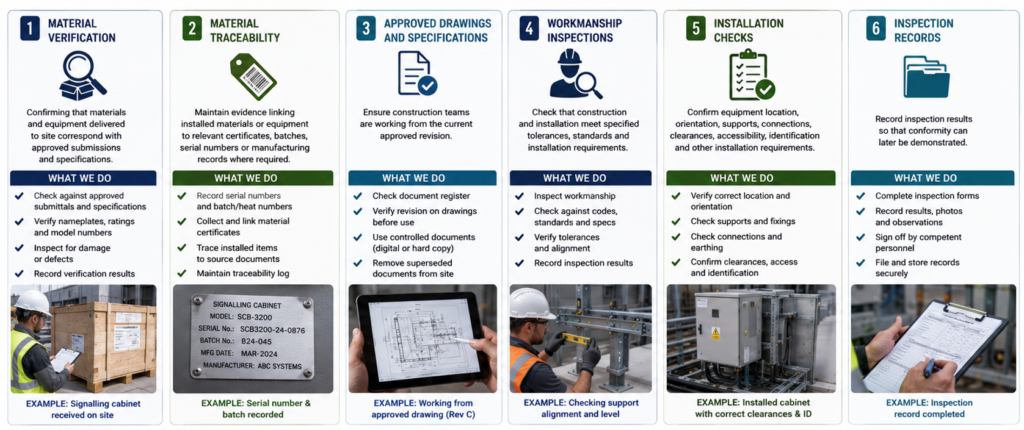
ISO 9001 provides the management framework, while project-specific Inspection and Test Plans, inspections, factory tests, installation records and non-conformance processes provide much of the evidence that the works conform to requirements.
A typical quality-control sequence can be considered as:
Hold Point
A Hold Point (H) is a mandatory stage where work cannot proceed until the required inspection or verification has been completed and formal release has been given.
This is generally used for activities where proceeding further could conceal important work or make subsequent correction difficult.
STOP → INSPECT → ACCEPT → RELEASE → CONTINUE
Witness Point
A Witness Point (W) provides the nominated party with the opportunity to witness an inspection or test.
The activity is notified in advance and may proceed in accordance with the agreed procedure if the witnessing party does not attend, subject to the project’s requirements.
Surveillance Point
A Surveillance Point (S) allows monitoring or observation of an activity while it is being undertaken.
Surveillance provides assurance that approved procedures, workmanship and quality requirements are being followed during execution.
Review Point
A Review Point (R) involves reviewing documentation or evidence associated with the activity.
This could include certificates, inspection records, calculations, test results or other quality documentation.

4.1 Factory Acceptance Testing (FAT)
Quality control begins before railway equipment reaches the construction site. Many railway systems and equipment are manufactured and tested at factories before shipment. Factory Acceptance Testing (FAT) provides an opportunity to demonstrate that equipment meets specified requirements before it is released for delivery. FAT normally follows an approved test procedure with defined acceptance criteria. The uploaded T&C plan similarly places FAT before subsequent installation and site acceptance activities within the project’s overall testing progression.
4.2 Non-Conformance Reports (NCRs)
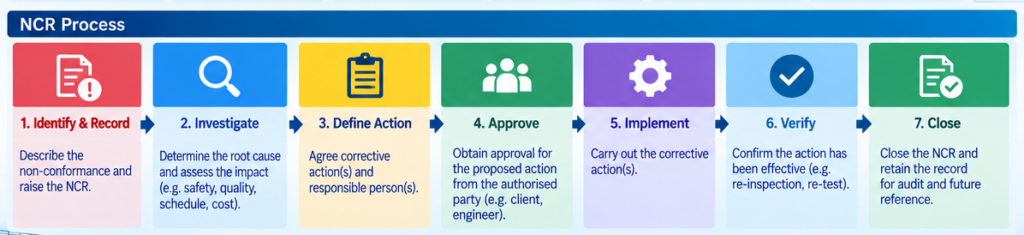
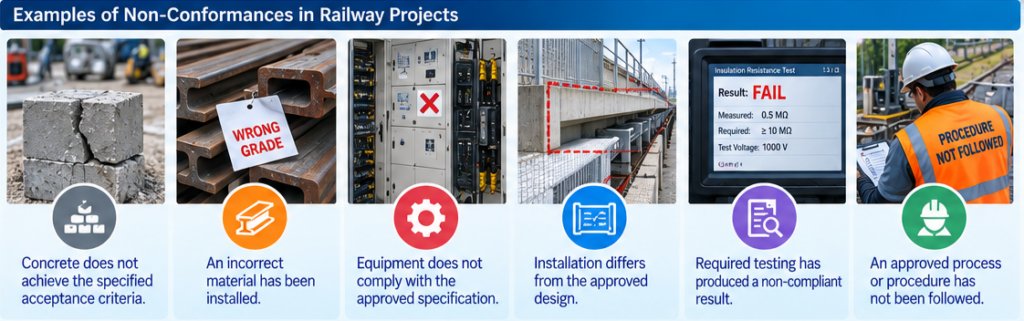
Not everything will conform perfectly during a large railway programme. A Non-Conformance Report (NCR) provides a controlled mechanism for recording and managing situations where a product, material, installation, process or result does not comply with a specified requirement. The purpose of an NCR is not simply to record that something went wrong. It provides a structured process for determining what happened, what should be done about it and how satisfactory closure will be demonstrated.
4.3 Punch Lists
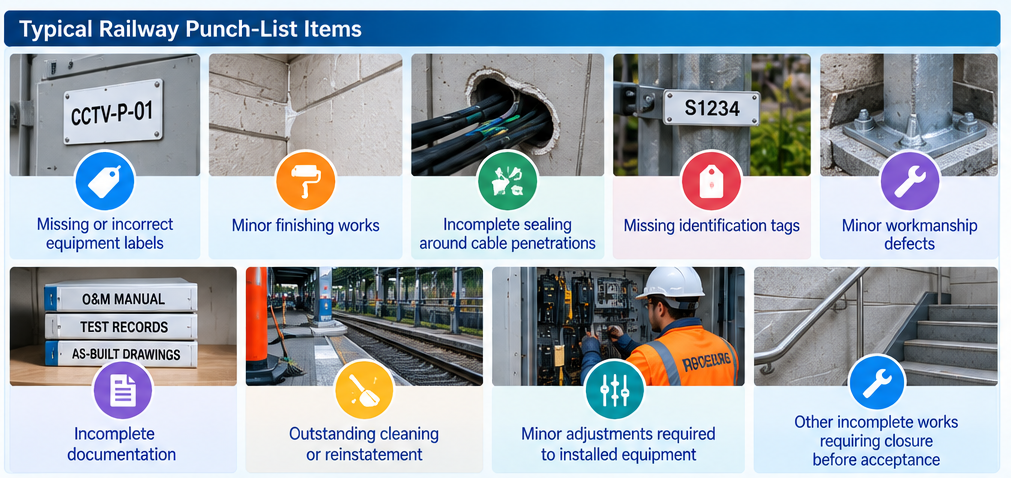
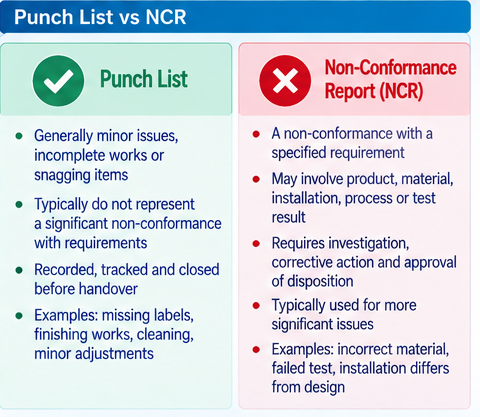
During construction, installation and Testing & Commissioning, railway projects inevitably identify defects, incomplete works and items requiring correction. These issues need to be recorded, assigned, tracked and formally closed before the relevant asset or system can progress toward acceptance. Two terms frequently encountered during this process are Punch List and Non-Conformance Report (NCR). Although they are sometimes used loosely, they serve different purposes.

5 Quality Control in the Testing & Commissioning Phase
Once construction and installation are sufficiently complete, quality control moves into the Testing & Commissioning (T&C) phase. At this stage, the focus shifts from demonstrating that railway assets have been correctly manufactured and installed to demonstrating that equipment, subsystems and the integrated railway perform in accordance with their specified requirements. For a complex railway, this is a progressive process. Individual equipment is tested first, followed by subsystems, interfaces and eventually the complete integrated railway under increasingly realistic operating conditions.
5.1 Inspection & Test Plan and Readiness
Before testing begins, the project should demonstrate that the system is ready to be tested and that the necessary quality controls are in place. For each testing stage, an Inspection and Test Plan (ITP) should define the required inspections and tests, applicable acceptance criteria, responsibilities, records to be produced and the relevant Hold, Witness, Surveillance and Review Points. The ITP provides the quality-control framework for demonstrating that prerequisite activities have been satisfactorily completed and that testing is undertaken in a controlled and traceable manner.
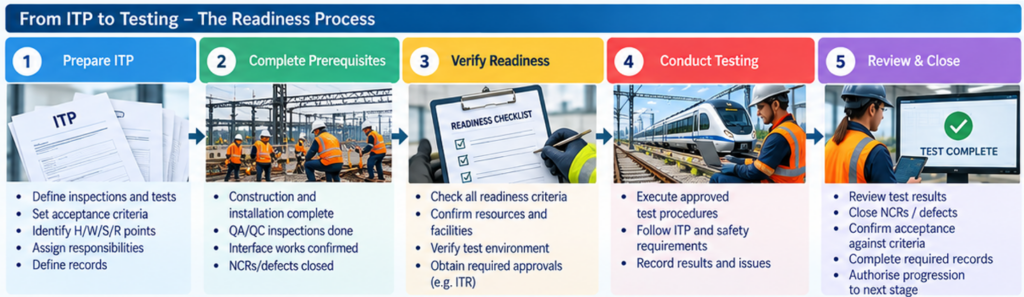
Test readiness may include confirmation of:

Each stage has a different quality objective and should normally be completed with the required evidence before progression to the next stage.
5.2 Factory Acceptance Test – FAT
VTA Stage: Verification (Off-site)
Factory Acceptance Testing takes place before equipment is delivered to site.Its objective is to verify the equipment design and functionality before delivery. Typical activities include: Type Test Review → Routine Test Verification → Functional Testing at Factory
Prerequisites include approved designs and specifications, applicable type-test certificates and completion of manufacturing.
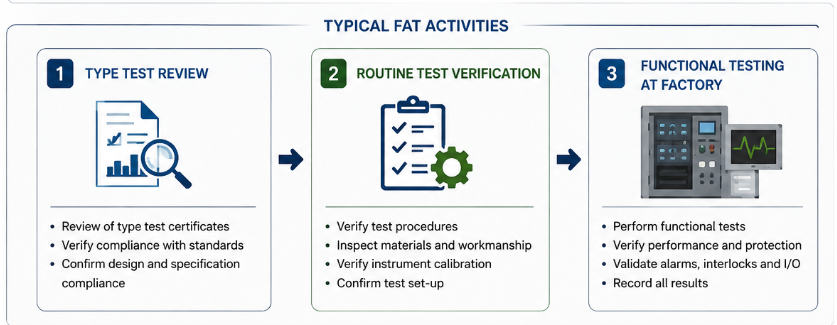
Manufacturing Complete → FAT → Compliance Demonstrated → Release for Delivery
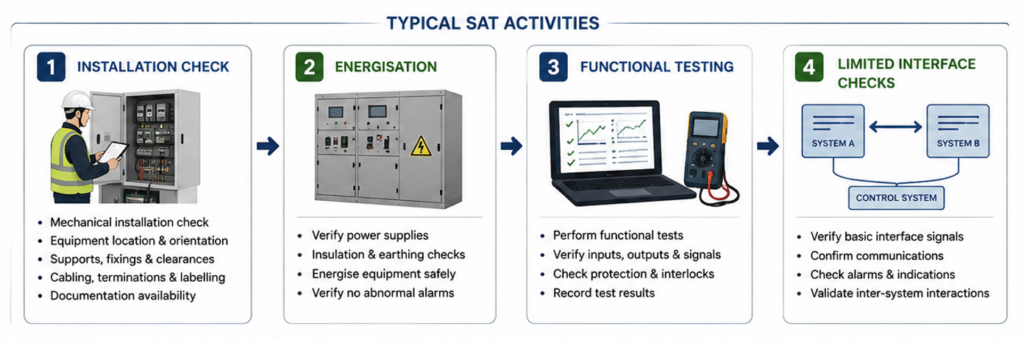
5.3 Site Acceptance Test – SAT
VTA Stage: Testing (On-site – Individual Systems)
Once equipment has been installed, SAT verifies that the installation and system functionality are satisfactory in the actual site environment. Typical activities include: Installation Check → Energisation → Functional Testing → Limited Interface Checks
Before SAT begins, installation should be sufficiently complete, the necessary QA/QC clearance and ITR approval should be available, and applicable FAT activities should have been completed. SAT therefore provides an important bridge between installation quality and system testing. Its outputs include SAT reports and installation verification records.
5.4 System Integration Test – SIT
VTA Stage: Testing (Integrated Systems)
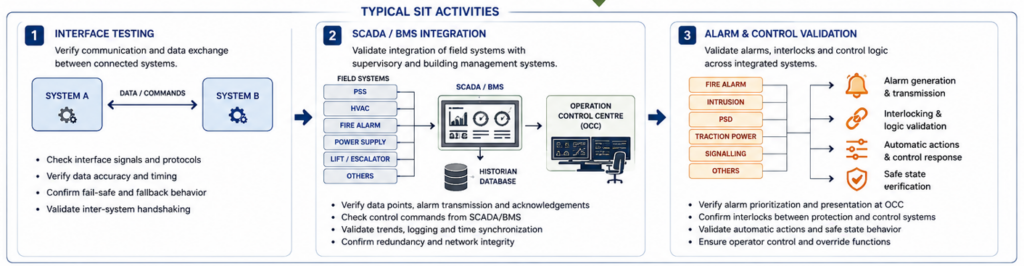
Passing SAT demonstrates that individual systems function correctly. It does not necessarily demonstrate that they will function correctly when connected to other railway systems. SIT therefore validates interactions between multiple systems.
Typical activities shown in your testing framework include: Interface Testing → SCADA/BMS Integration → Alarm & Control Validation
This stage is particularly important for railways because of the large number of system interfaces. Prerequisites include SAT completion, interface readiness and an appropriately controlled configuration baseline. The principal outputs are SIT reports and integrated test results.
5.5 Dynamic Testing
VTA Stage: Validation
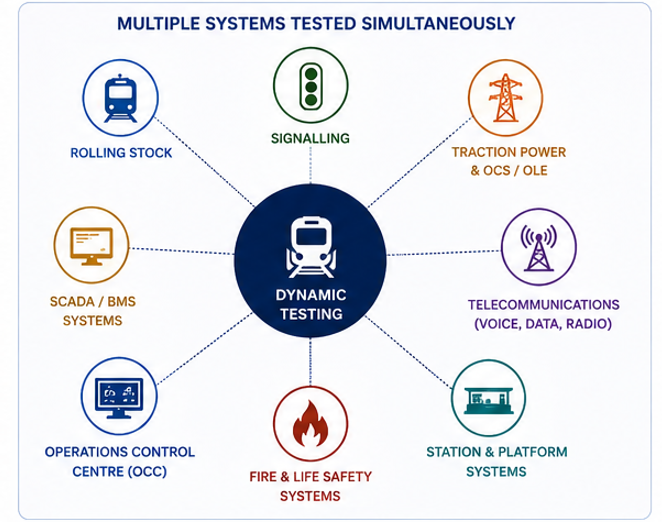
Dynamic Testing moves beyond individual and integrated static system testing and begins demonstrating the performance of the railway under operational or representative operating conditions. Your framework identifies SODT / MDT / SODT within this stage.
Typical activities include: Train Movement Simulation → Load Testing → Emergency Scenarios → Operational Performance Testing
Before dynamic testing can commence, integrated testing should be sufficiently complete, systems should be energised and coordination with the Operations Control Centre (OCC) should be established. Dynamic testing may involve multiple railway systems simultaneously, including: Rolling Stock + Signalling + Traction Power + OCS/OLE + Telecommunications + OCC + Stations + Platform Systems. The principal output is the dynamic testing evidence and reports demonstrating system performance under operational conditions.

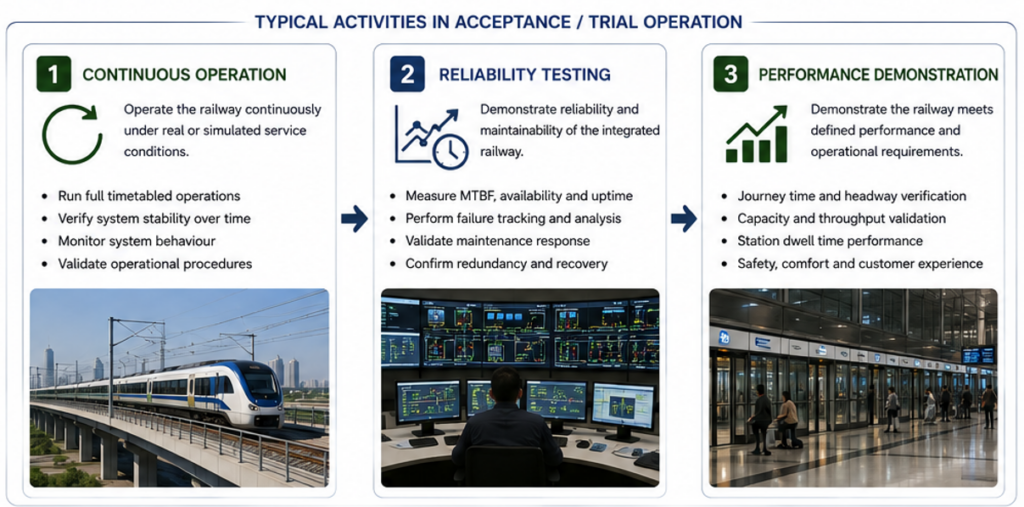
5.6 Acceptance and Trial Operation
VTA Stage: Acceptance
The final stage moves from technical system testing toward demonstrating that the railway is ready for operation.Typical activities identified in your framework include: Continuous Operation → Reliability Testing → Performance Demonstration Successful dynamic testing and the necessary authority approvals are prerequisites before progressing into this stage.The quality evidence generated throughout the preceding stages is then consolidated to support final acceptance and handover.Typical outputs include the Taking-Over Certificate and handover documentation.
6 Handover Phase Quality Checks
Railway handover is not simply the transfer of completed infrastructure and systems to the client or operator. It is the process of demonstrating, through physical completion, verification, documented evidence and formal acceptance, that the railway assets and systems have been delivered in accordance with the applicable requirements and are suitable to transition into operation and maintenance
From a quality perspective, handover should provide a controlled and traceable body of evidence demonstrating the progression from:
Requirements → Approved Design → Construction & Installation → Inspection → Testing & Commissioning → Defect Closure → As-Built Configuration → Acceptance → Handover
6.1 Documented Information and Traceability
Railway projects generate an enormous amount of technical and quality information throughout their lifecycle. Under an ISO 9001 Quality Management System, this information needs to be appropriately created, reviewed, approved, controlled, retained and made available when required.
The objective is not simply to maintain documents. It is to create a reliable evidence trail showing how the railway progressed from an approved requirement and design through construction, testing and ultimately acceptance.
6.2 Document Control
Engineering and construction teams must be able to identify and use the correct, current and authorised information.Typical controlled railway documents include:
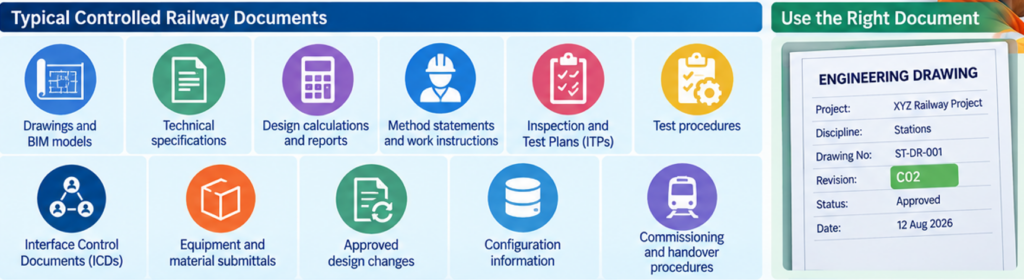
Revision and approval control is particularly important. If a design changes, the project needs to ensure that affected teams are working from the latest authorised revision and that superseded information is prevented from unintended use.
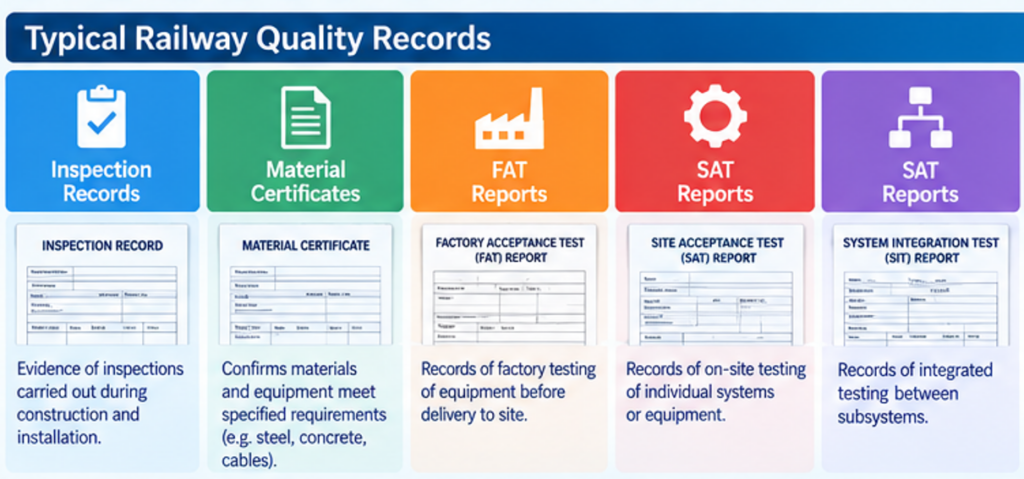
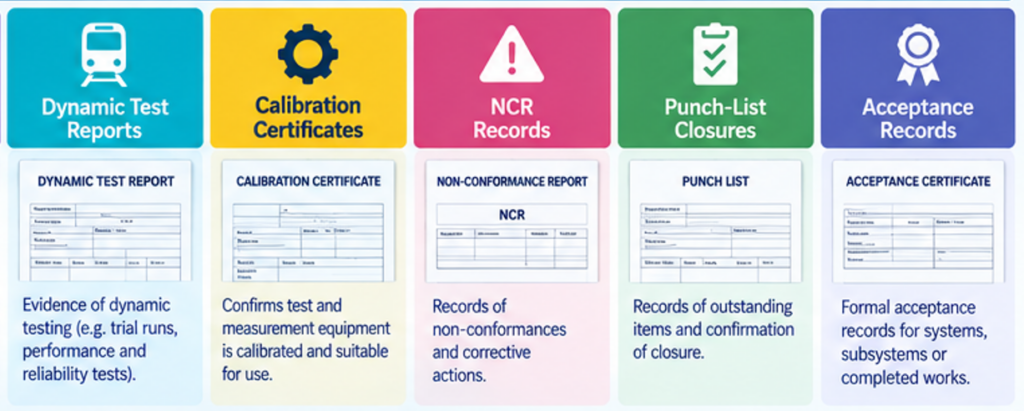
6.3 Quality Records
While drawings and procedures generally describe what should be done, quality records provide evidence of what was actually done. Typical railway quality records include:
6.4 Calibration Records
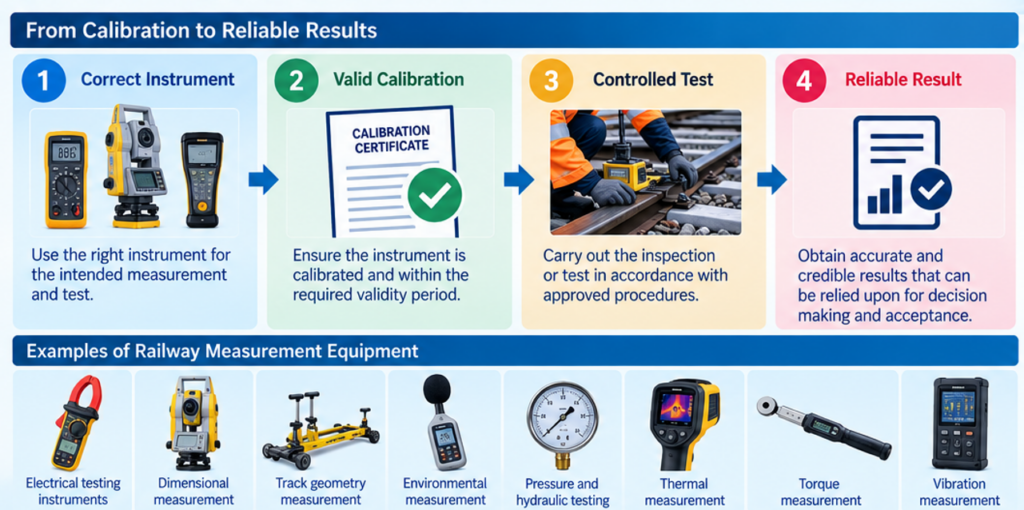
Inspection and testing results are only reliable when the equipment used to obtain those results is suitable for its intended purpose.
Where measurement equipment affects the validity of results, the project should maintain appropriate calibration or verification records.
This could apply to instruments used for electrical testing, dimensional measurement, track geometry, environmental measurements and other railway testing activities.
6.5 NCR and Defect Records
Non-conformances, defects and their resolution also form part of the project’s documented quality history.An NCR record should allow the project to understand:

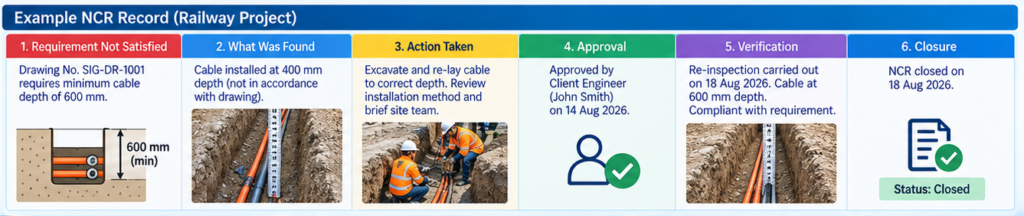
Maintaining this traceability is particularly important where corrective work affects previously completed inspections or testing.
6.6 Configuration Records
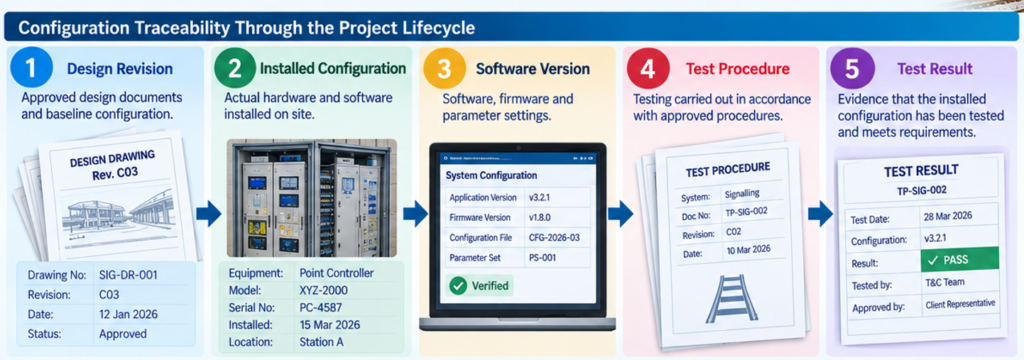
Configuration management and document control are closely connected.
A railway system may contain different versions of hardware, software, drawings, parameters and technical documentation. The project needs to know which configuration was installed and, importantly during T&C, which configuration was actually tested.

6.7 As-Built Documentation
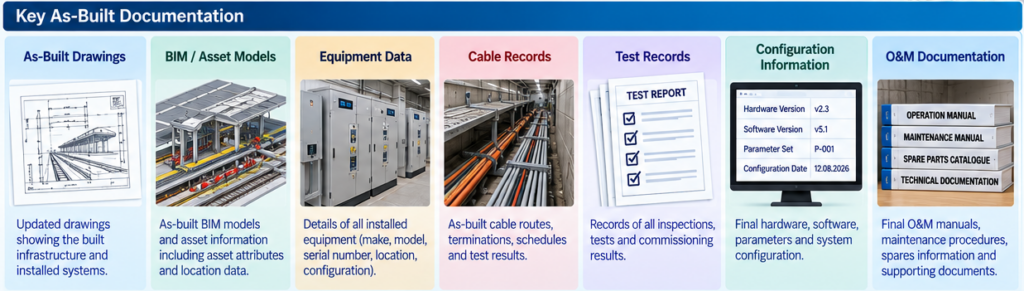
As construction and installation are completed, design information is progressively updated to reflect the railway that was actually built.
As-built documentation can include:
As-Built Drawings → BIM/Asset Models → Equipment Data → Cable Records → Test Records → Configuration Information → O&M Documentation
Accurate as-built information is important not only for handover but also for the railway operator, who may depend on these records for operations, maintenance, fault investigation, modifications and future upgrades throughout the asset’s life.
Creating End-to-End Traceability
The real value of documented information is its ability to connect different stages of railway delivery.
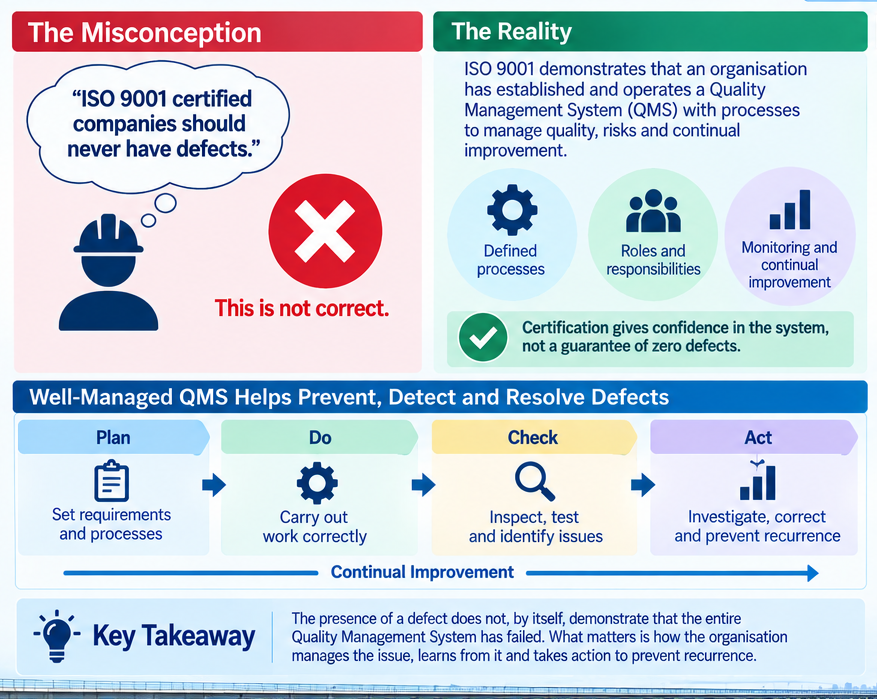
7 Common Misconception: ISO 9001 Does Not Mean “No Defects”
A common misunderstanding is that an organisation certified to ISO 9001 should never produce defects or experience quality problems.
That is not what ISO 9001 certification means.
ISO 9001 provides a framework for establishing and operating an effective Quality Management System (QMS). Certification provides assurance that the organisation has established processes for managing quality, but it does not guarantee that every drawing, component, installation or completed railway asset will always be defect-free.
This distinction is particularly important in railway projects.
Defects Can Still Occur
Railway delivery involves thousands of activities performed by designers, manufacturers, contractors, suppliers and testing teams. Even within a well-managed QMS, problems can occur, such as:
- incorrect or incomplete installation;
- workmanship defects;
- damaged materials or equipment;
- design coordination issues;
- manufacturing defects;
- failed inspections or tests;
- incorrect documentation;
- software or configuration issues; and
- non-compliance with specified requirements.
The presence of a defect does not, by itself, demonstrate that the entire Quality Management System has failed.
The more important question is:
How does the organisation identify, control, correct and learn from the problem?
ISO 9001 Provides a Controlled Response
An effective QMS should provide mechanisms for identifying and controlling non-conforming outputs and taking appropriate corrective action. For a railway project, a typical quality cycle could be: Issue Identified → Record → Assess → Contain → Correct → Verify → Close → Analyse → Improve
Depending on the nature of the issue, it might be managed through an NCR, defect report, punch list, test-failure report or another approved project process.Significant or recurring problems may require further investigation to determine their root cause and identify actions that can prevent recurrence.
Correction and Corrective Action Are Different
This is an important quality-management distinction. A correction addresses the problem that has already occurred.
For example:
An incorrectly installed cable support is repositioned to the correct location.
A corrective action addresses the cause of the problem to help prevent it from happening again.
For example:
Investigation finds that installers were using an obsolete drawing. The document-control and site-issue process is then improved to prevent superseded drawings from being used.
Conclusion – Quality Is a Lifecycle, Not an Inspection
Quality in railway projects cannot be achieved simply by inspecting the finished railway at the end of construction. By that stage, many important decisions have already been made, materials have been incorporated into permanent works, equipment has been installed and complex systems have been integrated.
Effective quality management must therefore begin with the requirements and continue throughout the entire railway lifecycle:
Requirements → Design → Procurement → Manufacturing → Construction → Installation → Testing & Commissioning → Handover → Operations & Maintenance