

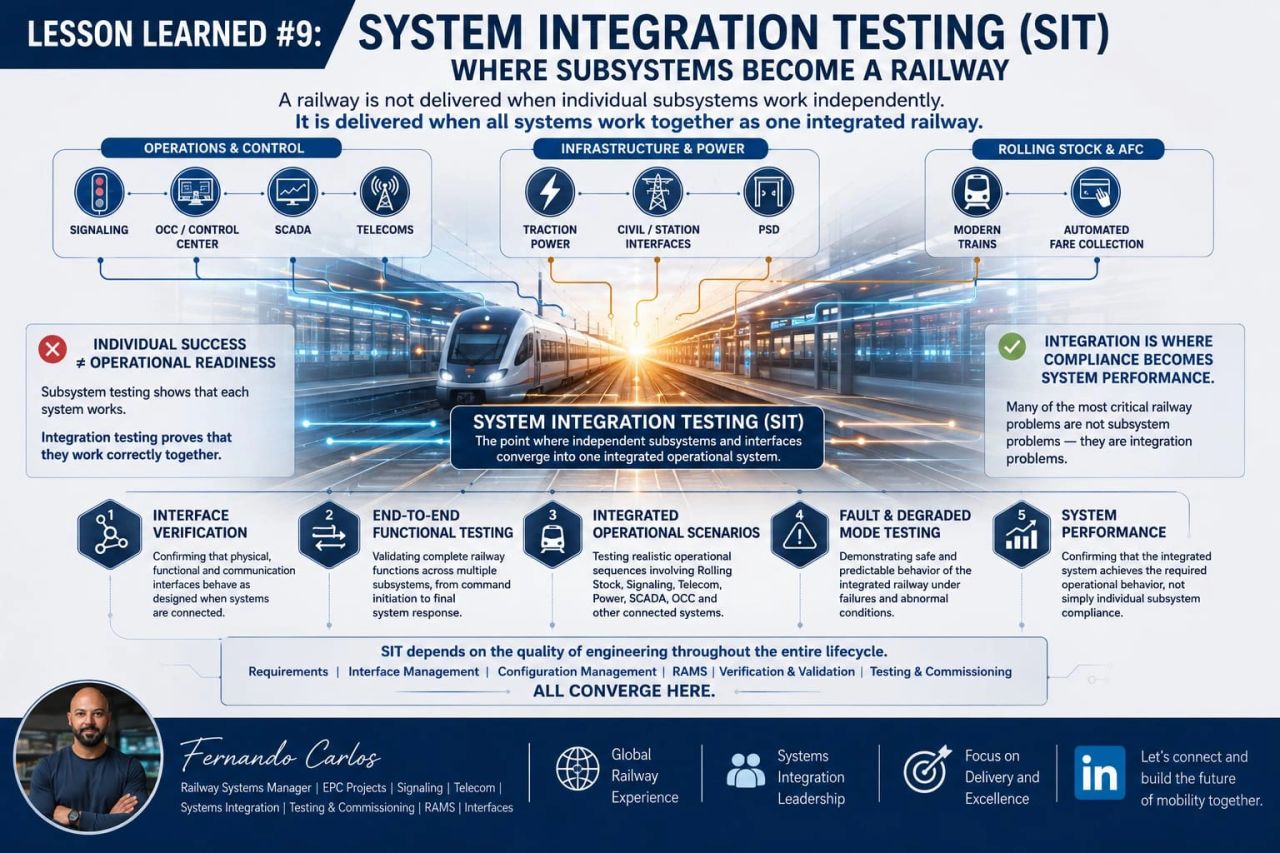
Author’s Note / Republished with Permission
This article was originally published by Fernando Carlos on LinkedIn and is republished on RailBays with the author’s permission. The views and technical perspectives expressed in this article are those of the author. The original illustration accompanying the article is also reproduced with permission and remains credited to Fernando Carlos.
Orginal post : Post | LinkedIn
A signalling system can pass its tests.
A train can pass its tests.
Telecommunications, Traction Power and SCADA can all pass their individual tests.
And the railway can still fail during integration.
Why?
Because a railway is not a collection of independent subsystems.
It is an integrated operational system where commands, data, physical interfaces, operational sequences and safety functions must work together—consistently and under different operating conditions.
This is where System Integration Testing (SIT) becomes critical.
Subsystem testing demonstrates that individual systems perform according to their requirements.
Integration testing must demonstrate something different:
/!\That those systems perform correctly together./!\
This requires:
• Interface Verification
Confirming that physical, functional and communication interfaces behave as designed when systems are connected.
• End-to-End Functional Testing
Validating complete railway functions across multiple subsystems, from command initiation to final system response.
• Integrated Operational Scenarios
Testing realistic operational sequences involving Rolling Stock, Signaling, Telecom, Power, SCADA, OCC and other interconnected systems.
• Fault & Degraded Mode Testing
Demonstrating that the integrated railway responds safely and predictably when equipment, communications or operational functions fail.
• System Performance
Confirming that the complete integrated system achieves the required operational behavior, not simply individual subsystem compliance.
System Integration Testing should therefore not be treated as an isolated activity planned only after subsystem testing is completed.
It is where Requirements Management, Interface Management, Configuration Management, RAMS, Verification & Validation and Testing & Commissioning converge.
Its effectiveness depends on the quality of engineering decisions made throughout the entire project lifecycle.
From my experience delivering international railway EPC projects, one lesson is clear:
– A subsystem can be technically compliant and the railway can still fail as an integrated system.
– Integration is where individual compliance must become system performance.
Ultimately, a railway is delivered when all systems work together safely, reliably and consistently as one integrated operational system.
How early does System Integration Testing influence the engineering and commissioning strategy of your projects?
RailBays Editorial Observation
Fernando Carlos highlights an important distinction that is sometimes underestimated on complex railway programmes: successful subsystem testing does not, by itself, demonstrate that a railway is ready for operation.
From a systems engineering perspective, SIT is where many assumptions made during design become physically testable. An interface may have been correctly defined in an ICD, allocated through requirements management and independently verified by each subsystem supplier, yet problems can still emerge when the systems are connected and required to respond as a complete railway.
This is particularly important because railway interfaces extend beyond simple equipment-to-equipment connections. They include functional, physical, electrical, communications, operational and safety interfaces, as well as the timing and sequencing of actions across multiple systems.
A useful example is an emergency scenario at a station. What appears to be a single operational event may require coordinated responses from signalling, rolling stock, SCADA, telecommunications, fire detection, ventilation, traction power, platform systems and the OCC. Each subsystem may satisfy its individual specification while the overall sequence still fails because of an incorrect interface, configuration mismatch, communication delay or conflicting operational logic.
This is why effective SIT arguably begins long before the first integrated test is performed. Requirements traceability, interface management, configuration control, RAMS activities and verification planning undertaken during design establish the conditions for successful integration later.
Another important aspect is degraded-mode testing. Normal-operation scenarios demonstrate that the railway can work when its systems are available; degraded and failure scenarios demonstrate whether it can remain safe and operationally manageable when they are not. These scenarios often expose dependencies that are difficult to identify through standalone subsystem testing.
Fernando’s central observation therefore has a wider systems-engineering implication:
Integration should not be viewed simply as the final stage of testing. It is an outcome of engineering decisions made throughout the project lifecycle.
For major railway programmes involving multiple contractors and system suppliers, this also reinforces the importance of establishing integration responsibilities early. Someone must own not only the individual interfaces, but also the end-to-end operational functions that cross contractual and subsystem boundaries.
Ultimately, the measure of successful integration is not whether every subsystem has passed its individual tests, but whether the railway as a whole can perform its intended operational and safety functions reliably under normal, degraded and emergency conditions.