

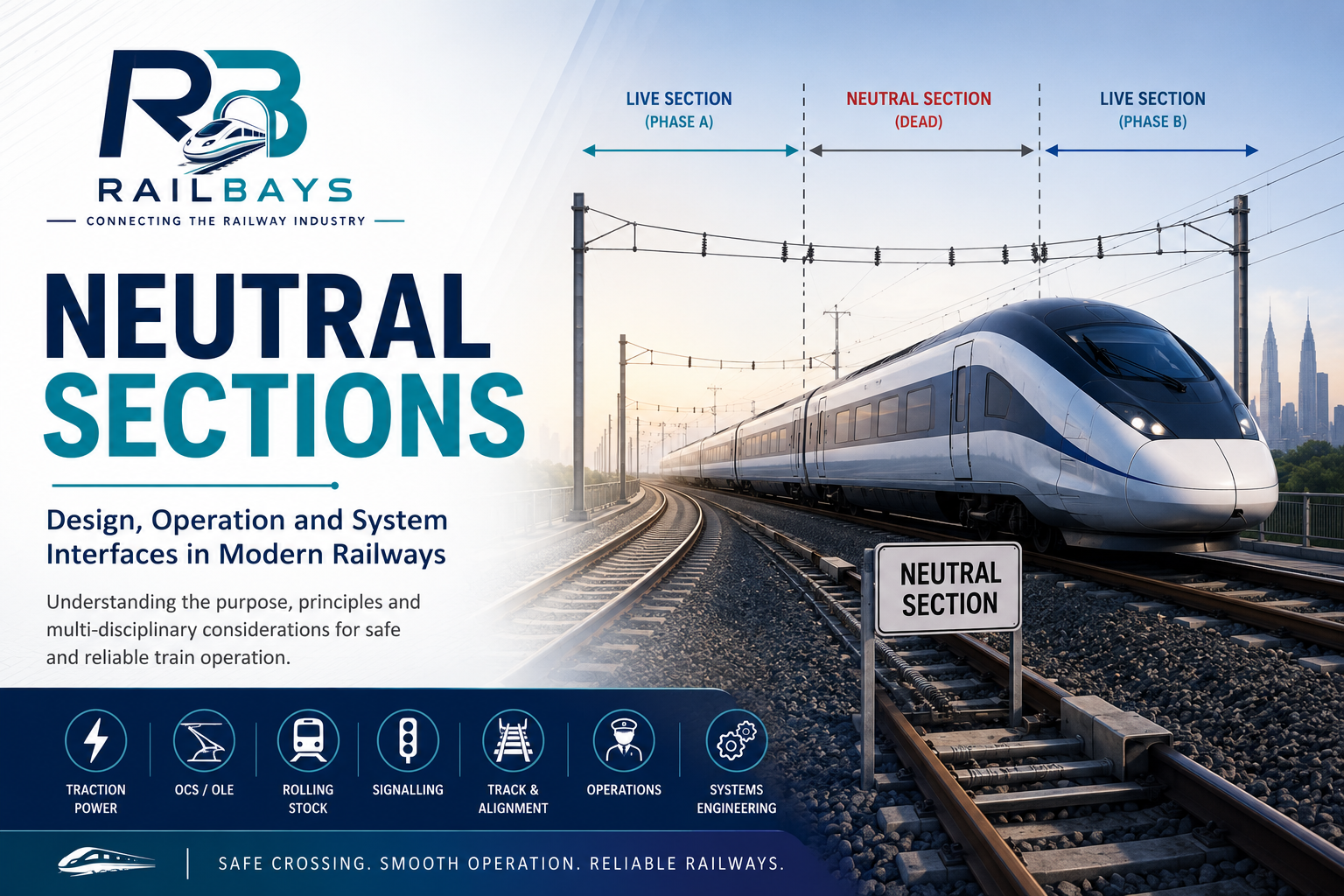
For passengers travelling on an electrified railway, the overhead contact system can appear to be one continuous electrical supply stretching for kilometres along the railway.Electrically, however, it is anything but continuous.A railway electrification system is divided into electrical sections supplied from different feeding points. At certain boundaries, those supplies must be prevented from being electrically connected together.
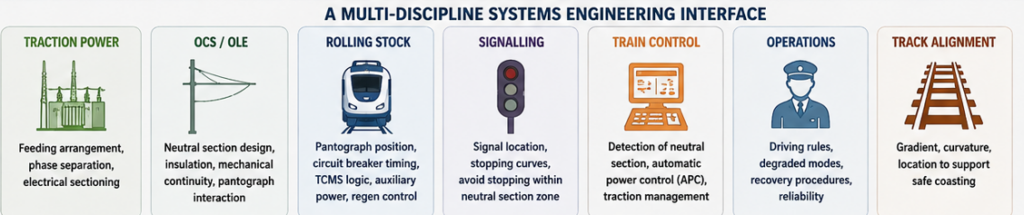
This is where the neutral section comes in. A neutral section is a short electrically isolated section of the overhead contact system through which an electric train normally passes without drawing traction power.The train does not stop. Instead, it uses its existing momentum to coast through the neutral section before traction power is restored.Although the physical arrangement may occupy only a relatively short length of railway, its design requires coordination between:
Understanding neutral sections is therefore an excellent example of railway systems engineering in practice.


Why Are Neutral Sections Required?
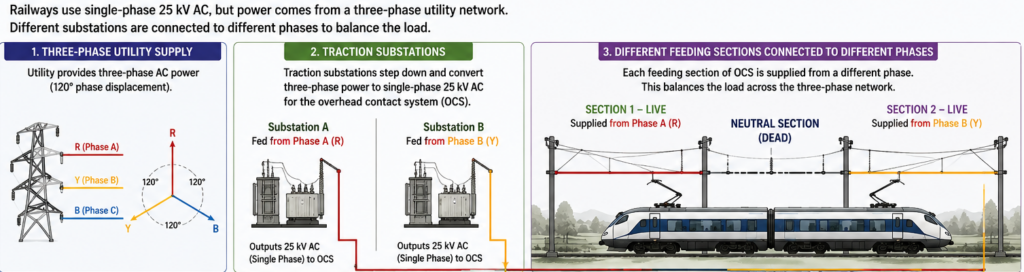
Consider a typical 25 kV AC railway electrification system.Electricity available from the public utility network is normally three-phase AC. Railway traction systems, however, commonly supply trains using single-phase AC.Traction substations distributed along the railway transform and feed electricity into the overhead contact system.Different feeding sections may be connected to different phases of the utility supply. This arrangement helps distribute railway traction demand across the three-phase electrical network
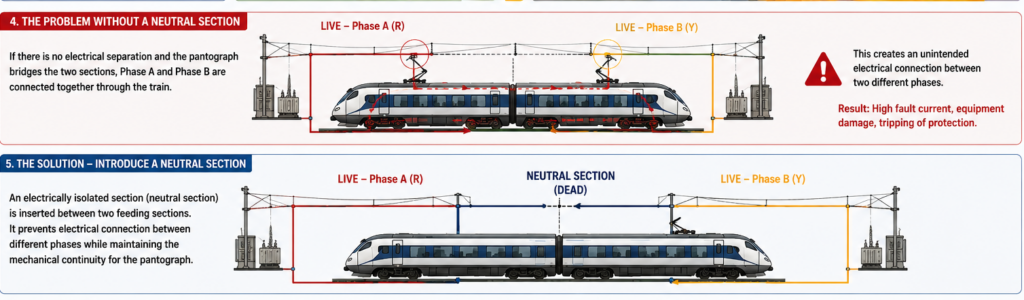
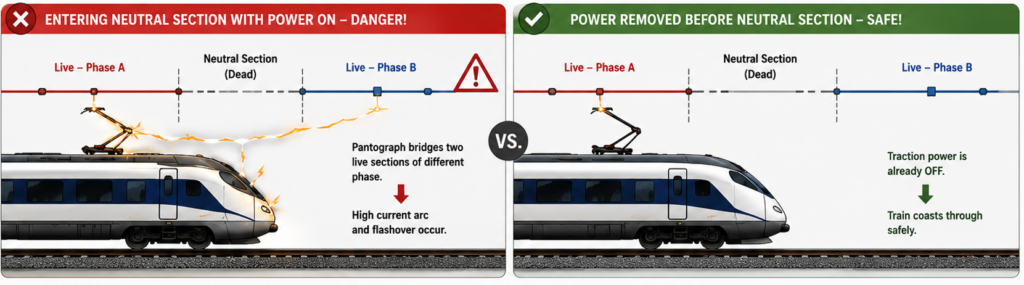
But it creates an important problem.Two adjacent overhead sections may not have the same instantaneous electrical phase.They therefore cannot simply be connected together.If a train’s pantograph were allowed to electrically bridge the two sections, it could effectively connect two supplies that must remain separated.An electrically isolated section is consequently introduced between them.
That section is the neutral section.
Simplified principle

The neutral section provides electrical separation while maintaining the mechanical path required for the pantograph to travel beneath the overhead system.
What Happens When a Train Reaches a Neutral Section?
The train normally approaches the neutral section under power.Before entering it, traction demand is removed and the train’s main high-voltage circuit is opened in the required sequence.
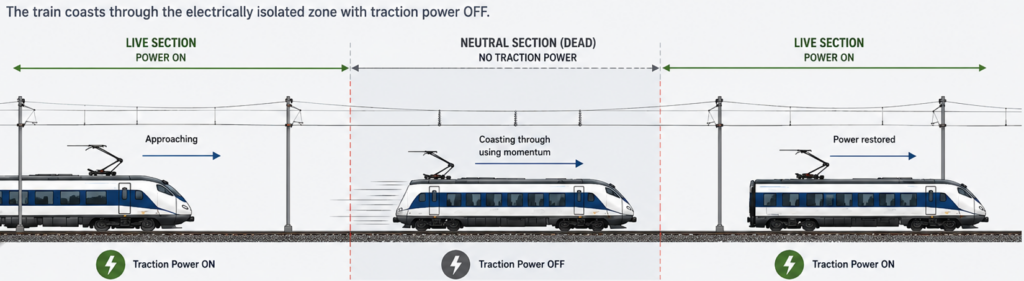
The train therefore passes through the neutral section using its kinetic energy.Once the train has cleared the electrically isolated zone, the high-voltage circuit can be restored and traction power reapplied.
A simplified sequence is:
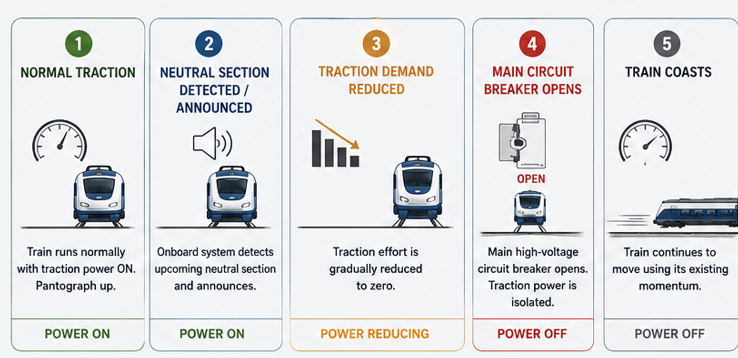
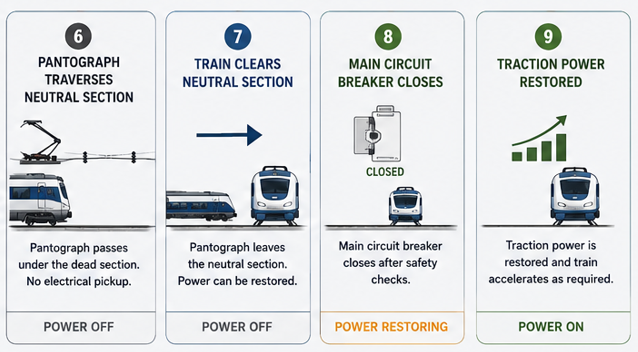
Modern rolling stock can perform much of this sequence automatically.
Why Must the Train Stop Drawing Power Before Entering?
Opening or interrupting a high traction current at the wrong location can produce electrical arcing.The pantograph/contact-wire interface is designed to provide continuous current collection while the train is drawing power. A neutral section intentionally introduces electrical discontinuity.The train must therefore remove traction current before crossing the electrical boundary.
This helps prevent:
- electrical arcing;
- flashover;
- excessive wear or damage to contact-system components;
- unwanted bridging of different electrical supplies; and
- electrical disturbances to onboard or wayside equipment.
The objective is therefore not merely to make the section electrically dead.
It is to ensure the train crosses the electrical boundary in a controlled power-off condition.
The Train Must Coast Through
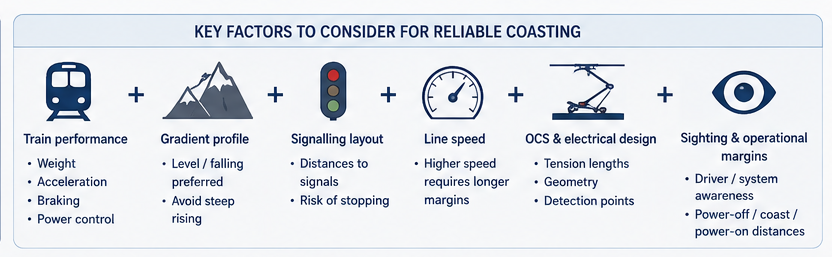
This simple requirement has major consequences for railway design.A train entering a neutral section must have sufficient momentum to pass completely through it.That means neutral-section location cannot be determined purely by the traction-power designer.Imagine placing one immediately after a station stop on a steep rising gradient.
A heavy train accelerates from the station, traction power is removed almost immediately, and the train then has to coast through the neutral section while climbing.That may create an unacceptable risk of poor performance or, in an extreme scenario, the train failing to clear the neutral section.The same issue can arise if a train is stopped by signalling immediately before or within the neutral-section operating zone.

Neutral-section positioning is therefore also an operations and train-performance problem.
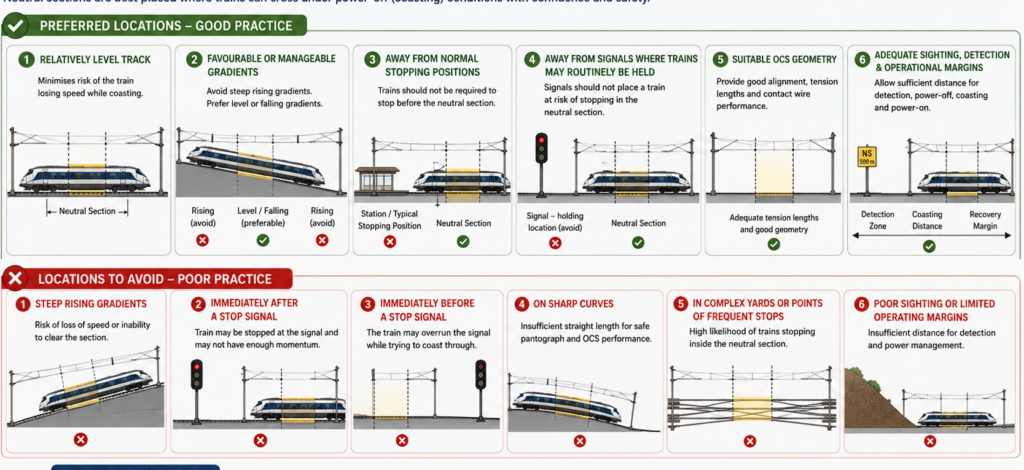
Where Should a Neutral Section Be Located?
As far as practical, designers seek locations where trains can reliably coast through the section under credible operating conditions.
Preferred locations generally include:
- relatively level track;
- favourable or manageable gradients;
- locations away from normal stopping positions;
- locations away from signals where trains may routinely be held;
- locations with suitable OCS geometry; and
- locations providing adequate sighting, detection and operational margins.
Locations on severe rising gradients require particular attention.
The design question should not simply be:
Where does the electrical feeding arrangement require a phase boundary?
It should also ask:
Can every applicable train safely and reliably negotiate that boundary under the required operating scenarios?
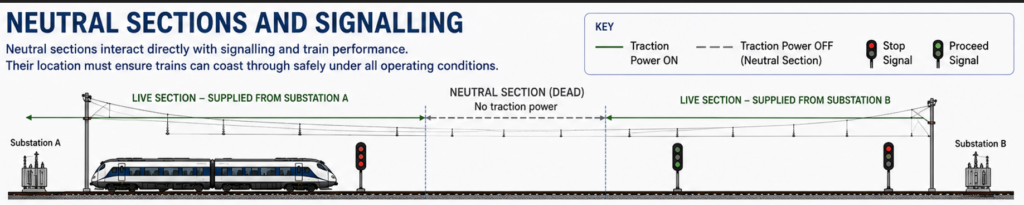
Neutral Sections and Signalling
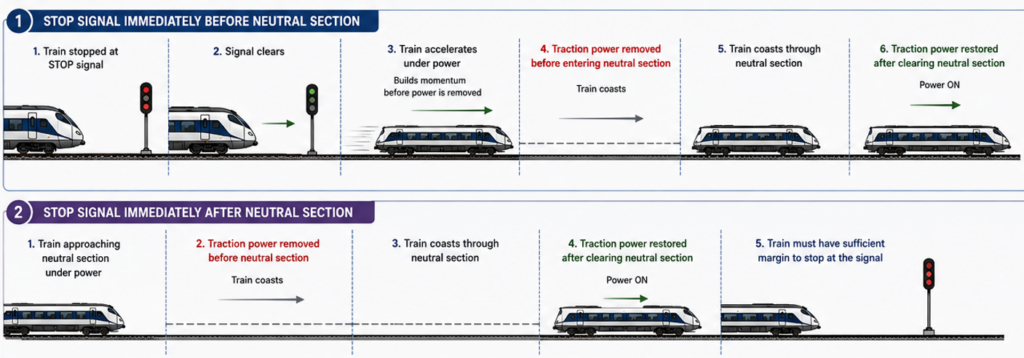
This is one of the most important multidisciplinary interfaces.Suppose a stop signal is positioned immediately before a neutral section.A train could be brought to a stand at the signal.When the signal clears, the train must accelerate sufficiently before traction power is removed so that it can coast through the neutral section.
Now consider a signal immediately beyond the neutral section.The signalling arrangement must not create an operating scenario in which a train attempts to maintain momentum through the neutral section and consequently approaches the stop signal in an undesirable manner.For this reason, neutral-section design and signalling layout cannot be developed independently.
The design needs to consider:
Signal position + braking curves + train acceleration + gradient + neutral-section length + operating rules
The uploaded guidance illustrates this particularly well. It specifies minimum separation principles between neutral sections and stop signals under different gradients, demonstrating that the issue is fundamentally a train-performance and signalling interface rather than an OCS detail alone.
Rolling Stock Is Equally Important
The train itself determines how the neutral section is negotiated.
Important rolling-stock parameters include:
- pantograph position;
- number of pantographs raised;
- distance between pantographs;
- train length;
- traction configuration;
- main circuit-breaker operating time;
- traction ramp-down time;
- traction restoration time;
- auxiliary-power behaviour;
- regenerative-braking behaviour; and
- neutral-section detection equipment.
The physical neutral section may only be several metres or tens of metres long, but the effective traction-free distance experienced by the train can be much longer.
Why?
Because traction cannot necessarily be restored instantaneously at the exact point where the pantograph leaves the neutral section.The train control and high-voltage systems require time to restore the electrical configuration and ramp traction back up.At high speed, even a few seconds correspond to a significant distance.
Automatic Power Control
Traditional railway systems may rely heavily on lineside signs and driver action.Modern railway systems increasingly automate the process.Trackside equipment can identify the approach to a neutral section, while onboard equipment communicates with the Train Control and Management System (TCMS).
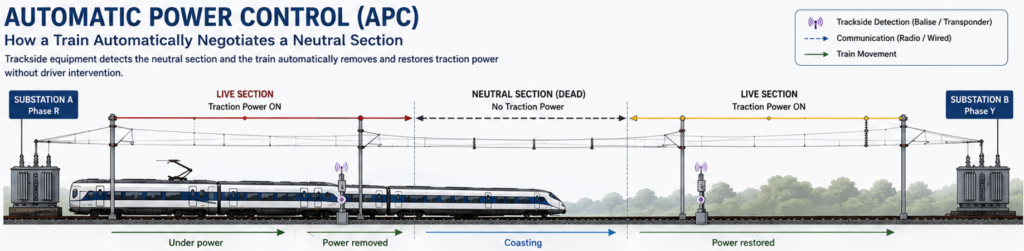
A simplified automatic sequence can be:
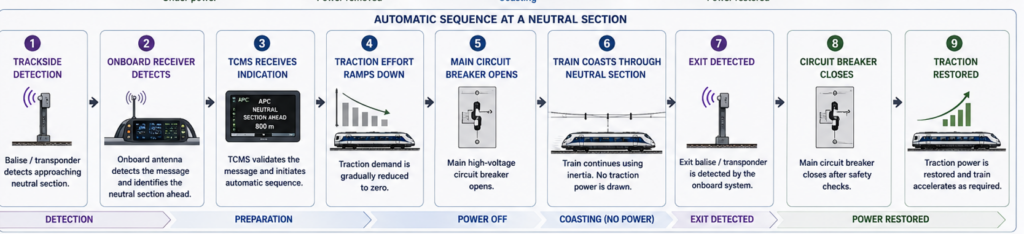
This type of arrangement is commonly associated with Automatic Power Control (APC) or equivalent neutral-section detection functionality.Automation reduces dependence on precise manual driver intervention and becomes particularly important for high-speed and highly automated railways.
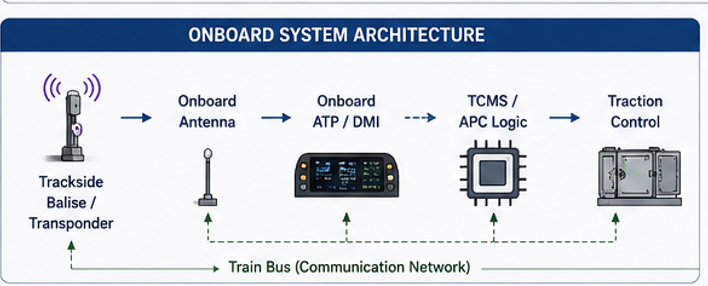
Conventional Neutral Sections
Neutral sections have been implemented in several different forms.One traditional arrangement is the overlap-type neutral section.
The overhead system maintains the mechanical continuity required for the pantograph while providing electrical separation between the two live feeding sections.
.Conceptually:
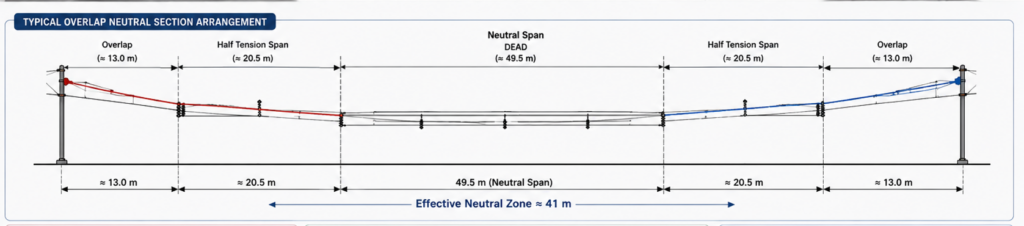
The pantograph therefore continues following the contact-wire system mechanically without allowing the adjacent electrical sections to become directly connected.
Short Neutral Sections
Where conventional arrangements are difficult to accommodate, a short neutral section may be used. This is including designs using section insulators or composite insulating components.Short neutral sections can reduce the physical length required for the electrical separation.
However, shorter does not automatically mean better.Section-insulator-based arrangements introduce additional mass and discontinuities into the overhead contact system. Depending on the design, this can influence:
- pantograph dynamic behaviour;permissible speed;
- contact force;
- component wear;
- maintenance requirements; and
- reliability.
For higher-speed railway applications, pantograph–OCS dynamic performance becomes particularly important.
Neutral Sections Are Also a Pantograph Dynamics Problem
At high speed, the pantograph is not simply sliding underneath a perfectly rigid wire.The pantograph and overhead contact system form a dynamic mechanical system.The contact wire moves vertically as the pantograph passes. Contact force changes continuously, and additional components or changes in stiffness and mass can disturb the interaction.Neutral-section equipment can therefore become a challenging location for current-collection performance.
Poor geometry or inappropriate component installation may contribute to:
- excessive contact forces;
- contact loss;
- arcing;
- accelerated contact-wire wear;
- pantograph-strip wear; and
- maintenance problems.
This is why high-speed neutral-section design increasingly involves dynamic OCS simulation, installation optimisation and measurement of actual pantograph behaviour.
What Happens to Auxiliary Systems?
Removing traction power does not necessarily mean that the entire train suddenly becomes electrically dead.Modern electric trains contain numerous auxiliary systems, including:
- lighting;
- train control;
- communications;
- ventilation;
- passenger information;
- control electronics; and
- safety systems.
Depending on rolling-stock architecture, onboard batteries, DC links and auxiliary power arrangements can maintain essential systems while the train crosses the neutral section.
This again demonstrates why neutral-section design requires detailed coordination with the rolling-stock supplier.
Regenerative Braking Must Also Be Considered
Electric trains do not only consume electrical power.
During regenerative braking they can return electrical energy to the traction power system.
Consequently, entering a neutral section while regenerative braking is active also requires appropriate control.
The train-control system must manage regenerative braking and traction-power isolation so that electrical energy is not incorrectly transferred across the section boundary.
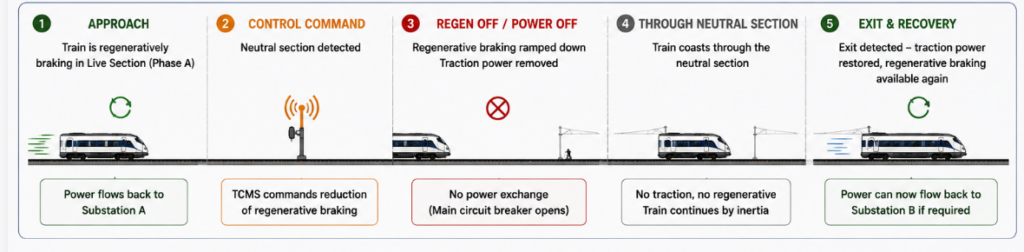
Neutral-section logic therefore needs to consider both: Motoring and Regenerative braking
What If a Train Stops Inside the Neutral Section?
This is one of the undesirable operational scenarios designers seek to avoid.If the pantograph is positioned beneath an electrically dead section, the train may be unable to obtain traction power.Recovery depends on the railway and rolling-stock design.
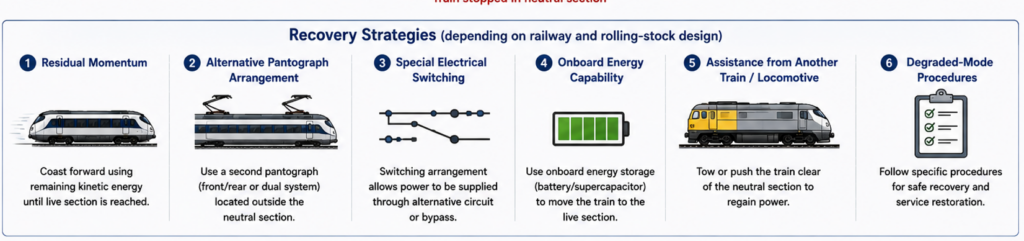
The preferred engineering solution, however, is to minimise the probability of the train stopping there in the first place. That takes us back to the importance of alignment, signalling and train-performance analysis.
Neutral Section vs Section Insulator
These terms are sometimes confused.
A section insulator is an OCS component used to electrically separate adjacent sections while permitting pantograph passage.
A neutral section is the overall electrical arrangement used to prevent incompatible electrical supplies from being bridged.
Section insulators can therefore form part of a neutral-section arrangement, but the terms are not interchangeable.
Similarly, not every electrical sectioning point is necessarily a neutral section.
Neutral Sections on High-Speed Railways
High-speed operation makes the design considerably more demanding.At 300 km/h, a train travels approximately:83 metres every second.Even small delays in traction shutdown or restoration therefore translate into substantial distances.

A neutral section may physically occupy only a short part of the railway, while its systems influence extends hundreds of metres around it.
Neutral Sections Are a Systems-Engineering Interface
Neutral sections demonstrate why railway infrastructure cannot be designed discipline by discipline.
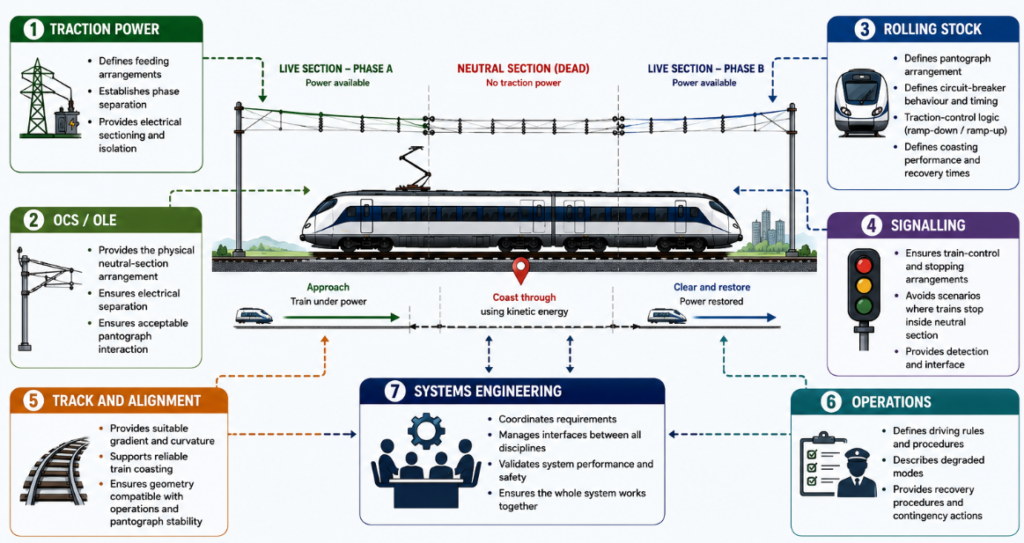
A Simple Design Question That Becomes a Complex Interface
At first sight, a neutral section appears to be little more than a short dead section in the overhead electrification system.
But asking a few questions quickly reveals the wider engineering problem:
Which electrical supplies are being separated?
Where should the section be located?
How fast will trains approach it?
What happens on an uphill gradient?
Where are the nearest signals?
Could signalling stop a train there?
Where are the pantographs located?
How quickly can the train open and close its main circuit breaker?
How is the neutral section detected?
What happens during regenerative braking?
What happens if a train loses speed?
What happens if the train actually stops inside it?
None of these questions belongs to only one railway discipline.
The Engineering Principle
A useful way to think about a railway neutral section is:
A neutral section is not simply a gap in the electrical supply. It is a controlled transition between two electrical feeding systems that the complete railway system must allow a train to negotiate safely and reliably.
The physical equipment may belong to the electrification system.But its successful operation depends on the railway functioning as one integrated system.That is what makes neutral sections such an interesting railway engineering interface.