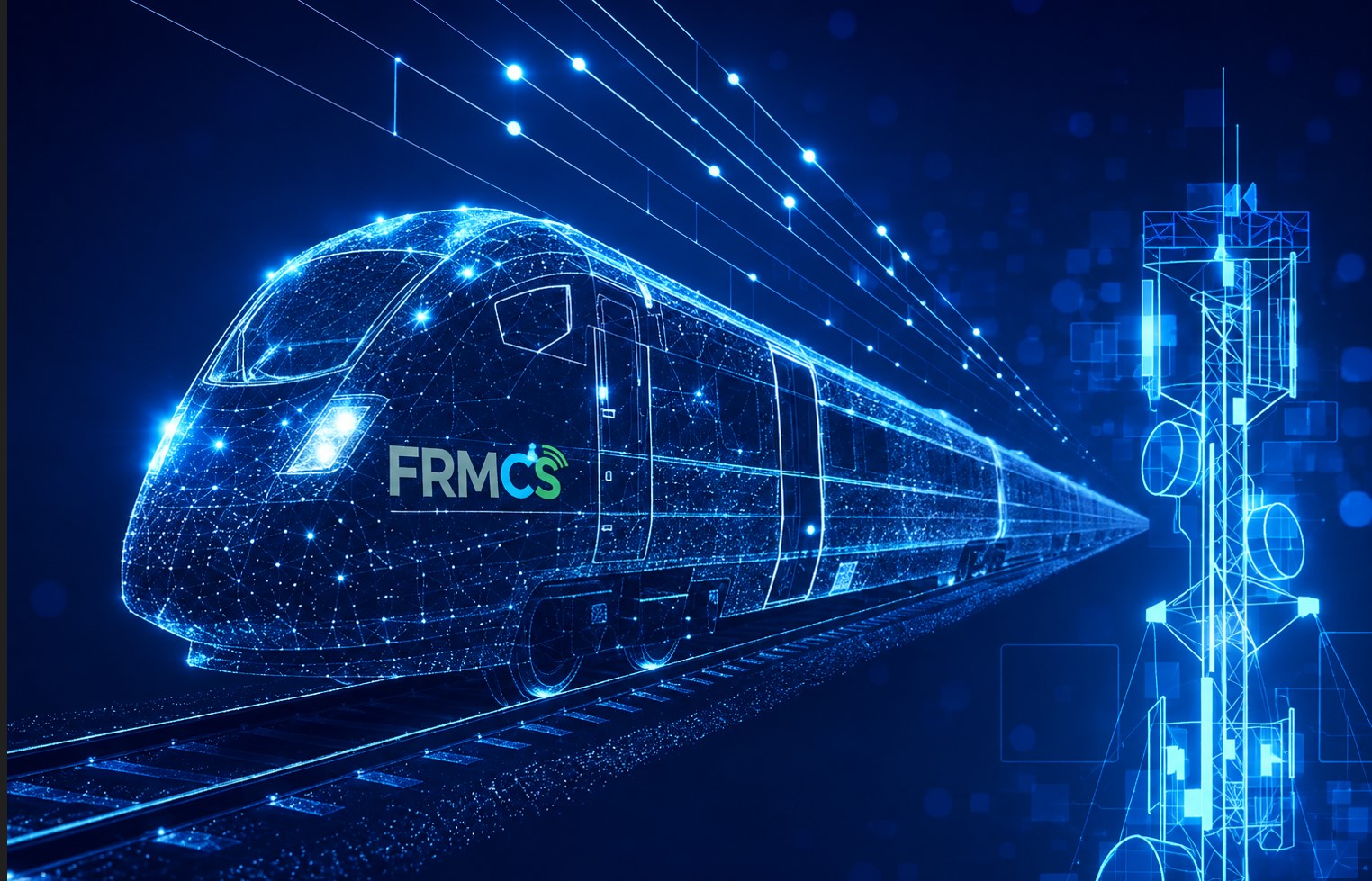
The 5G FRMCS Training & Certification course provides a technical introduction to the evolution of railway communications from legacy GSM-R toward the 5G-based Future Railway Mobile Communication System (FRMCS).
The course is aimed at railway engineers, telecommunications professionals and system integrators who need to understand the architecture, technologies and deployment considerations associated with FRMCS. It covers the role of 5G architecture, Quality of Service, mission-critical communications, network slicing, radio design and railway-specific application
Learning Outcomes
Participants will develop an understanding of the transition from GSM-R to FRMCS; 5G system architecture relevant to railway communications; FRMCS registration, session management and QoS; railway radio-layer design; network slicing and railway service prioritisation; integration of railway applications and APIs; mission-critical voice, video and data services; and operational considerations for FRMCS migration and deployment.
Who Should Attend
The course is particularly relevant to railway telecom engineers, communications engineers, railway systems engineers, network engineers, system integrators and professionals involved in planning or implementing FRMCS and next-generation railway communications. The provider specifically identifies telecom professionals, railway engineers and system integrators as the target audience
Modules / Syllabus
Module 1: Reimagining Railway Communications – From GSM-R to FRMCS
- Introduction to 5G system design and evolution from LTE.
- Core components of the 5G architecture relevant to FRMCS (AMF, SMF, UPF, PCF).
- SBA (Service-Based Architecture) and RESTful API exposure for railway applications.
- Functional overview of the IMS system and its role in delivering voice/video over IP.
- C-RAN and gNB-DU/ gNB-CU split concepts for centralized rail deployments.
Module 3: FRMCS UE Registration, Session Management, and QoS
- Detailed registration signaling flow for train-mounted UEs.
- How PDU sessions are set up for MCPTT, MCData, and MCVideo.
- Deep dive into 5QI values, ARP levels, and GBR/non-GBR mapping for rail services.
- Dynamic QoS modification during handovers and emergency broadcasts.
- Network slicing tailored to rail functions: operational, safety, and passenger slices.
- Authentication, authorization, and integrity assurance in FRMCS.
Module 4: FRMCS and 5G Radio Layer Design
- Frequency bands allocated for FRMCS (e.g., 874–876 MHz, 915–917 MHz).
- Duplexing modes: TDD vs. FDD for rural and dense metro corridors.
- Overview of 5G NR numerology and its impact on high-speed rail mobility.
- Frame structure and slot configuration recommendations for latency-sensitive rail apps.
- Practical coexistence strategies for GSM-R and FRMCS during the transition phase.
Module 5: Integrating Applications and APIs in Railway Networks
- FRMCS application layer: dispatcher systems, CCTV uplink, data acquisition.
- Key interface points: APIs between NEF and third-party control systems.
- Network exposure strategies for predictive analytics, monitoring platforms, and emergency alerts.
- How to expose real-time location, service availability, and diagnostic data to control centers.
- Introduction to MEC (Multi-access Edge Computing) and edge placement in rail environments.
Module 6: Mission-Critical Services and Group Communication Over 5G
- Architecture of MCx services and how they fulfill railway safety requirements.
- Setup of group communication for emergency and daily operational calls.
- Proximity-based communication using ProSe in tunnel and rural conditions.
- Multicast and broadcast (MBS) to disseminate information to multiple rail subsystems.
- Integration of MCPTT with emergency braking, train control, and alerting systems.
Module 7: Operational Considerations and Deployment Challenges
- Migration planning from GSM-R to FRMCS: phased vs. overlay models.
- Interoperability testing, pilot project frameworks, and KPI definition.
- Performance monitoring: jitter, latency, packet loss benchmarks for mission-critical flows.
- Real-time network adaptation to rail mobility patterns (handover frequency, signal blocking zones).
- Ensuring redundancy and availability in harsh environments.