

Summary and adaptation by: RailBays Editorial Team
🟩 Republished with Permission
Originally published on LinkedIn by Andrew Wagener. Republished with the author’s permission.
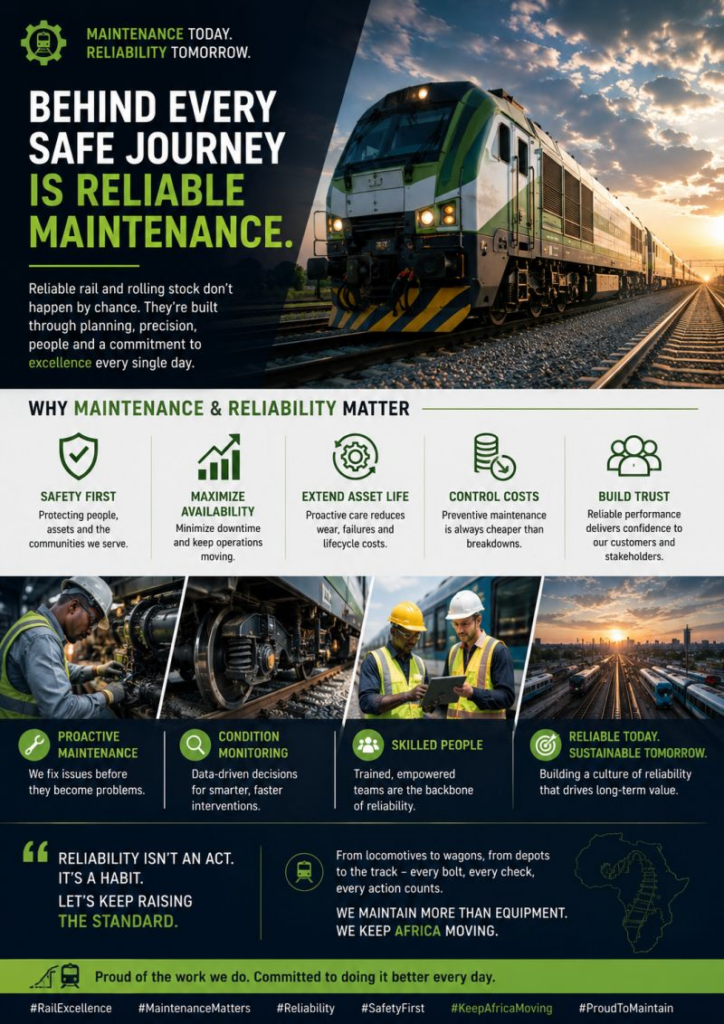
Image reproduced with permission from Andrew Wagener.Copyright
Original infographic and concepts © Andrew Wagener. Republished with permission.
Introduction
In many industries, maintenance is often viewed as an operational expense that should be minimised. However, in the railway sector, this perspective can be costly. Every locomotive, passenger coach, freight wagon and kilometre of railway infrastructure depends on disciplined maintenance to ensure safe, reliable and efficient operations.
As Andrew Wagener explains, maintenance is not simply about repairing equipment after it fails—it is a long-term investment in safety, reliability and operational excellence. Modern railway organisations increasingly recognise that effective maintenance strategies improve service availability, reduce lifecycle costs and build passenger confidence.
Beyond Fixing Failures
Traditional maintenance focused primarily on repairing assets after a failure occurred. While corrective maintenance will always have a place, today’s railway operators strive to prevent failures before they disrupt operations.
A world-class railway maintenance strategy focuses on:
- Preventing breakdowns before they occur
- Maximising fleet availability and operational reliability
- Extending the service life of rolling stock and infrastructure
- Reducing lifecycle and operating costs
- Protecting employees, passengers and surrounding communities
- Delivering dependable service to customers
The emphasis has shifted from reacting to failures to proactively managing asset health throughout its entire lifecycle.
Why Maintenance Matters
Every maintenance activity contributes to the broader objectives of a railway organisation.
Safety First
Well-maintained assets reduce the likelihood of component failures that could compromise passenger and worker safety. Routine inspections, scheduled servicing and compliance with maintenance standards are fundamental to safe railway operations.
Maximising Availability
Railway operators aim to keep trains in service and infrastructure available for use. Effective maintenance minimises unplanned downtime, improves punctuality and supports reliable operations.
Extending Asset Life
Rolling stock and infrastructure represent significant long-term investments. Preventive maintenance helps reduce wear, identify defects early and maximise the useful life of critical assets.
Controlling Costs
Although maintenance requires continuous investment, proactive maintenance is generally far less expensive than emergency repairs, service disruptions or premature asset replacement. Managing assets throughout their lifecycle helps reduce total ownership costs.
Building Trust
Passengers, freight customers and stakeholders expect reliable railway services. Consistent maintenance performance strengthens confidence in the railway system and contributes to a positive reputation.
From Reactive to Proactive Maintenance
Modern railway maintenance has evolved significantly over recent decades.
Rather than waiting for equipment to fail, railway organisations increasingly adopt proactive approaches such as:
- Preventive maintenance based on scheduled intervals
- Predictive maintenance using condition monitoring data
- Reliability-centred maintenance (RCM)
- Digital asset management systems
- Continuous performance monitoring
These approaches enable maintenance teams to identify emerging issues before they become operational failures.
The Importance of Skilled People
Technology alone does not create reliable railways.
Andrew highlights that reliability depends upon:
- Disciplined planning
- Skilled maintenance teams
- Data-driven decision making
- Continuous improvement
Experienced engineers, technicians and maintainers remain the foundation of every successful maintenance programme. Their knowledge, inspections and professional judgement continue to play a vital role alongside modern digital technologies.
Looking Ahead
As railways continue their digital transformation, maintenance strategies are evolving to incorporate:
- AI-assisted fault prediction
- Remote condition monitoring
- Digital twins
- Internet of Things (IoT) sensors
- Predictive analytics
- Intelligent asset management platforms
These technologies support earlier fault detection, more efficient maintenance planning and improved asset performance throughout the railway lifecycle.
Key Takeaways
✔ Maintenance is a strategic investment rather than an operational cost.
✔ Reliability begins with proactive planning and disciplined execution.
✔ Safety, availability and asset longevity depend upon effective maintenance.
✔ Skilled maintenance professionals remain central to railway success.
✔ Continuous improvement and modern technologies are shaping the future of railway maintenance.
Conclusion
Reliable railways are not built by chance. They are the result of consistent planning, skilled professionals and a commitment to maintaining assets before problems occur.
By viewing maintenance as a long-term investment rather than a short-term expense, railway organisations can improve safety, maximise operational performance and deliver dependable services for passengers and freight customers alike.
As Andrew Wagener reminds us, maintenance excellence is not simply about keeping trains moving today—it is about building a safer, more reliable railway for the future.