

Introduction to Tunnel Boring Machines and Modern Railway Tunnelling
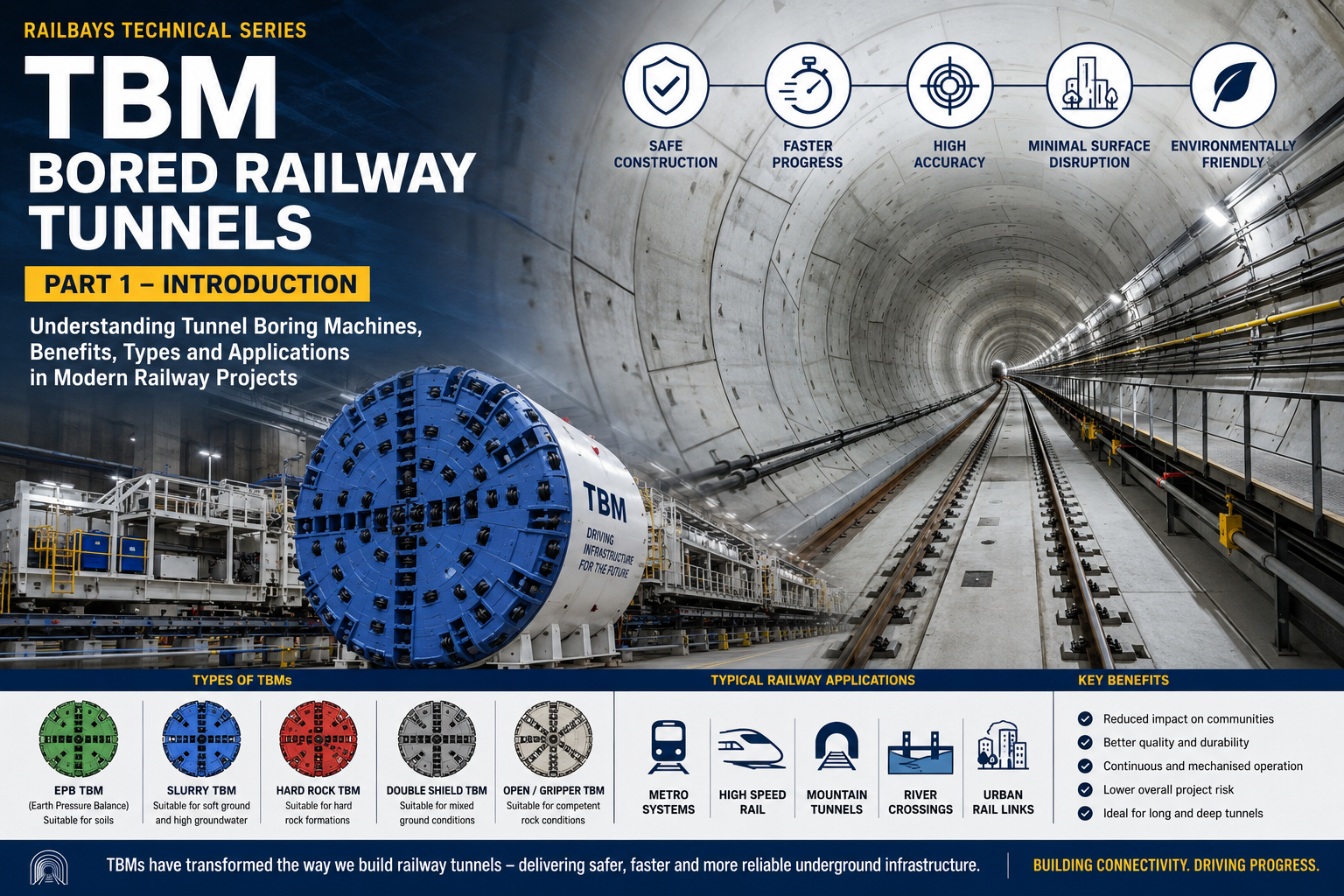
Modern railways increasingly rely on underground infrastructure to reduce surface disruption, improve urban mobility and overcome geographical constraints. Tunnel Boring Machines (TBMs) have transformed railway tunnelling by enabling long tunnels to be excavated safely, accurately and efficiently. Compared with traditional methods, TBMs provide better control of ground movement, lower environmental impact and improved worker safety. As metro and high-speed rail networks continue to expand worldwide, TBM technology has become the preferred solution for many underground railway projects.
What is a Bored Tunnel?
A bored tunnel is an underground tunnel excavated using a mechanical excavation system rather than being excavated from the surface. In railway applications, the tunnel is usually circular and lined with precast reinforced concrete segments installed immediately behind the TBM. The annular void between the lining and surrounding ground is backfilled with grout to provide uniform support and minimise settlement.
Why Choose a TBM?
TBMs are selected where long underground sections are required beneath densely populated areas, rivers, mountains or environmentally sensitive locations. They minimise disruption at the surface, reduce traffic impacts, improve construction safety and can maintain highly accurate tunnel alignment using laser guidance. Modern TBMs perform excavation, spoil removal, segment erection and grouting in a continuous sequence, allowing rapid progress once launched.
Advantages over Cut & Cover and NATM
Cut & Cover is economical for shallow tunnels but causes major surface disruption and utility diversions. NATM offers flexibility in variable geology but depends heavily on sequential excavation and ground monitoring. TBMs require high capital investment but are generally preferred for long railway tunnels because they deliver consistent excavation, high productivity, reduced settlement and excellent quality control.
Suitable Ground Conditions
Different TBMs are designed for different geological conditions. Earth Pressure Balance machines are commonly used in cohesive soils and mixed ground. Slurry TBMs are preferred in soft ground with high groundwater pressure, particularly beneath rivers. Hard Rock TBMs are used in competent rock formations, while Double Shield machines combine continuous excavation with simultaneous lining installation in suitable rock conditions.
Types of TBMs
Earth Pressure Balance (EPB) TBMs balance face pressure using excavated material and are widely used for metro projects. Slurry TBMs use pressurised slurry to support the tunnel face. Hard Rock TBMs employ disc cutters to fracture competent rock. Open or Gripper TBMs are suitable where rock quality allows the machine to react directly against the tunnel walls. Double Shield TBMs provide improved productivity by allowing excavation and segment erection simultaneously.
Typical Railway Applications
TBMs are used for metro systems, commuter railways, high-speed rail, mountain base tunnels, underwater crossings and airport rail links. They are particularly advantageous where long tunnels pass beneath urban developments and environmental impacts must be minimised.
Selected Project Examples
Examples include London’s Elizabeth line, Singapore MRT extensions, Hong Kong MTR projects, the Gotthard Base Tunnel in Switzerland, Riyadh Metro, Doha Metro and numerous high-speed rail tunnels in Europe and Asia. These projects demonstrate the capability of TBMs to construct large-diameter railway tunnels through a wide range of geological conditions.
Conclusion
TBMs have fundamentally changed modern railway tunnelling by delivering safer, faster and more predictable construction. Successful application depends on selecting the correct TBM for the ground conditions, integrating geotechnical investigations with structural design and planning the installation of railway systems from the earliest design stages. The next article in this series will examine the fundamentals of bored railway tunnel design, including tunnel diameter selection, segmental lining design, waterproofing, cross passages and fire and life safety requirements.
Suggested References
– ITA (International Tunnelling and Underground Space Association) guidance.
– EN 1997 (Eurocode 7 – Geotechnical Design).
– EN 1992 (Eurocode 2 – Concrete Structures).
– Project publications from major metro and high-speed rail programmes.