
A featured technical article by Teldat, republished on RailBays with permission.
Republished with Permission
This technical article was originally published by Teldat and is republished on RailBays with the company’s permission. The original work remains © Teldat. We thank Teldat for supporting knowledge sharing within the global railway community.
Every time a train moves safely across a busy network, an invisible system is working behind the scenes to make it possible. Signalling is the nervous system of the railway: the layer that decides which train can occupy which stretch of track, at what speed, and when. For most of rail’s history, that layer relied on fixed sections of track, lineside signals, and hardware bolted to the ground. Today it is being reinvented.
Europe sits at the center of this shift. The European Rail Traffic Management System (ERTMS) and its signalling component, the European Train Control System (ETCS), are converging with a new 5G communications backbone to create railways that are safer, more automated, and dramatically higher in capacity. This edition unpacks what “next-generation signalling” actually means, the technologies driving it, and why it has quietly become a strategic priority far beyond the rail sector itself.
This edition unpacks what “next-generation signalling” actually means, the technologies driving it, and why it has quietly become a strategic priority far beyond the rail sector itself. It is also the conversation we are preparing to bring to InnoTrans 2026 .
From fixed block to moving block
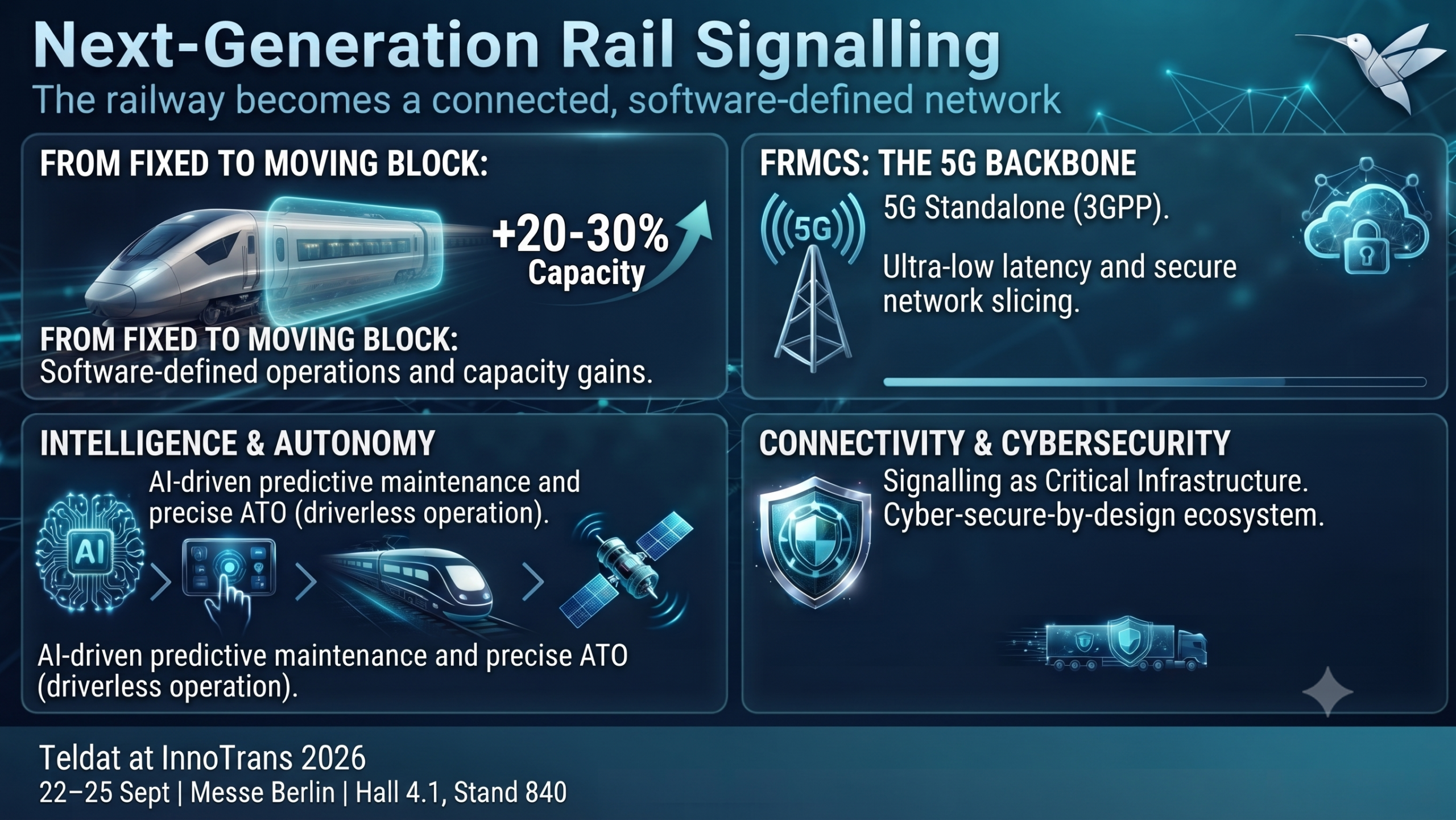
ETCS is the interoperable standard replacing dozens of incompatible national signalling systems, and it comes in three levels. Level 1 transmits movement authorities through Eurobalises on the track; Level 2 uses continuous radio communication to remove lineside signals altogether, and is now mature and widely deployed across Europe. Level 3 is the real leap, because it introduces moving block. Traditional fixed-block signalling divides the line into sections and allows only one train per section — safe, but wasteful of capacity. Moving block treats the train itself as the block, continuously computing a safe distance from the rear of the train ahead, so services can run far closer together. On congested corridors this promises capacity gains of roughly 20–30%. The catch is that Level 3 requires each train to report its own integrity, confirming no wagon has detached. This demands a degree of fleet standardization most networks have not yet reached to. For now, Level 3 largely exists as hybrid extensions of Level 2.
FRMCS: the 5G backbone
Moving block and automation only work if communication between train and trackside is continuous and ultra-reliable. That is the job of FRMCS, the Future Railway Mobile Communication System, the UIC-standardized successor to today’s GSM-R. GSM-R is approaching obsolescence around 2030 as vendor support fades, and FRMCS is built to replace it. Not on a rail-specific technology, but on 5G Standalone architecture standardized through 3GPP. It runs on the existing 900 MHz railway band plus a new 1900–1910 MHz band allocated by CEPT in 2020, delivering low latency, high reliability, and mission-critical voice, data and video. Crucially, its network slicing can isolate safety-critical train control from passenger connectivity on the same infrastructure. Trials are underway from 2026, with larger deployments expected toward 2028 and a long migration running to roughly 2035 as GSM-R is retired. FRMCS is the enabler beneath everything else. These are ETCS Level 3, automation and virtual coupling all depend on it.
Automation and intelligence
With a reliable digital backbone in place, the railway becomes a data platform. Automatic Train Operation (ATO) layers on top of ETCS to manage acceleration, braking and speed with a precision human drivers cannot match, improving punctuality and energy efficiency, as well as laying the foundation for higher grades of automation, up to fully driverless running. That same continuous data flow between train and trackside enables condition-based and predictive maintenance: sensors flag a failing component before it causes a delay, shifting operators from rigid schedules to intervention when it is actually needed. Satellite positioning is being explored to reduce trackside equipment further, and concepts such as virtual coupling. Trains running in coordinated convoys with minimal separation, which is the point to where the next capacity gains lie. Notably, EU rail and space agencies are already cooperating to embed satellite communications and positioning into future ERTMS and FRMCS systems.
Connectivity, cybersecurity and strategy
None of this is possible without secure, resilient connectivity. As signalling migrates from isolated hardware to IP-based, software-defined networks, the attack surface grows. And any rail is critical infrastructure. This connects directly to a theme from earlier editions, where the EU has designated four priority transport corridor: rail, road, sea and air, for military mobility, alongside hundreds of dual-use infrastructure projects, and both the European Commission and the rail associations now explicitly link ERTMS acceleration and cybersecurity to defence readiness. Digital control and signalling systems are named as potential targets for hybrid threats. The response is an open, cyber-secure-by-design signalling ecosystem: hardened communications, secure positioning, network segmentation, and the ability to recover quickly from an incident. Signalling has become both a question of mobility as well a security one.
Conclusion
Next-generation train signalling is far more than an upgrade to the equipment beside the tracks. It is the convergence of moving-block control, a 5G communications backbone, automation and cybersecurity into a single interoperable system. So that trains can move, more safely, across borders that were until recently a patchwork of incompatible national standards. The timelines are long and the migration is complex, running well into the 2030s, but the direction is unmistakable. The railway is becoming a connected, software-defined, data-driven network.
For Europe, the stakes are higher still. A signalling system that guarantees capacity, interoperability and resilience is now recognized as strategic infrastructure Essential to both a competitive single market and a credible defense posture. Connectivity and security sit at the very heart of that transformation. Indeed cybersecurity would need to be explored more closely and how it is being built into these corridors from the ground up.
Teldat will be at InnoTrans on 22–25 September (Messe Berlin: Hall 4.1 | Stand 840) to discuss cybersecurity and connectivity across rolling stock and mobility as critical infrastructure, along with the wider trends shaping the sector.
Come and visit us. We would be glad to continue the conversation in Berlin.
Original LinkedIn Article
https://www.linkedin.com/pulse/nervous-system-railway-next-generation-train-signalling-teldat-i9jye
About Teldat
Teldat is a global provider of secure networking, cybersecurity and communications solutions supporting digital transformation across transport, mobility and critical infrastructure. The company develops resilient networking technologies that enable secure, connected and intelligent railway operations.
Editor’s Note
RailBays is pleased to feature this technical article with permission from Teldat as part of our commitment to sharing high-quality engineering knowledge with the international railway community. The views and technical opinions expressed are those of the original author.