
Introduction
Railways have transformed the way people and goods move across the world for more than two centuries. From urban metro networks carrying millions of passengers every day to high-speed railways connecting major cities at speeds exceeding 350 km/h, modern railway systems have become one of the safest, most reliable and environmentally sustainable modes of transportation.
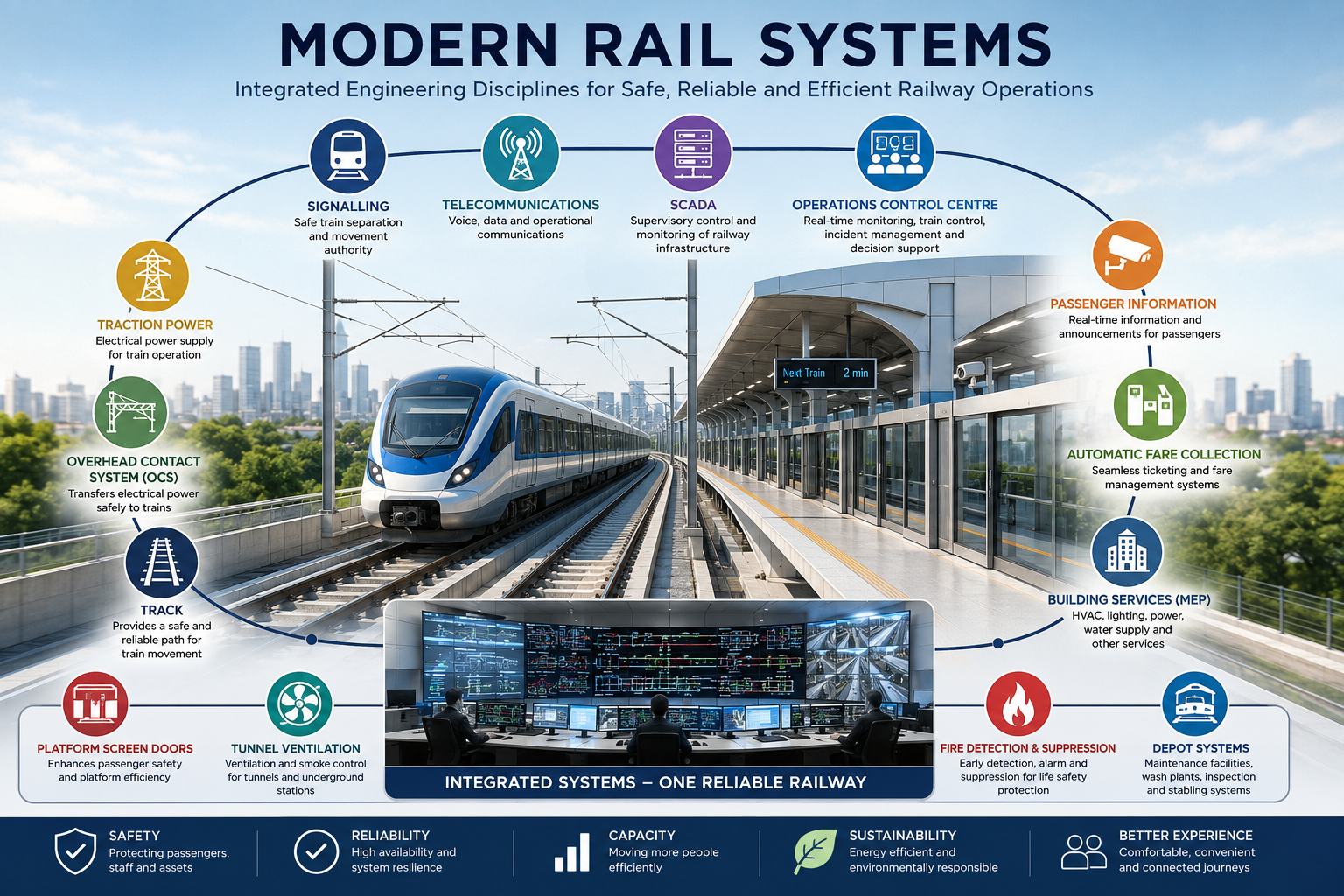
Behind every successful railway lies a complex integration of engineering disciplines working together to ensure trains operate safely, efficiently and reliably. While passengers often associate railways with trains and tracks, the reality is that a modern railway is a highly sophisticated system comprising numerous interconnected subsystems. These include signalling, telecommunications, traction power, overhead electrification, rolling stock, passenger information systems, tunnel ventilation, fire protection, supervisory control systems and many others.
Collectively, these engineering disciplines are known as Rail Systems.
Unlike civil infrastructure, which provides the physical structures such as tunnels, bridges, viaducts and stations, rail systems deliver the operational capability that allows trains to move safely, passengers to travel comfortably and operators to manage the railway efficiently.
Today’s rail systems incorporate advanced digital technologies including communications-based train control (CBTC), the European Train Control System (ETCS), artificial intelligence, predictive maintenance, cybersecurity, digital twins and cloud-based asset management. As railways continue to evolve towards automation and intelligent transportation, the importance of well-designed and fully integrated rail systems continues to grow.
This guide provides an introduction to modern rail systems, explains how the various engineering disciplines work together and highlights why effective systems integration is fundamental to the successful delivery and operation of railway projects.
Understanding Railway Infrastructure
A railway is much more than rails and trains. It is a complex transportation ecosystem comprising numerous engineering disciplines that must function together as a single integrated system.
For simplicity, railway projects are generally divided into two major engineering categories:
Civil Infrastructure
ivil infrastructure forms the physical backbone of the railway. Typical elements include:
- Stations
- Bridges and viaducts
- Earthworks
- Architecture
- Tunnels
- U-trough
- Depots
- Retaining structures
- Drainage systems
- Roads and access routes
- Buildings
- Utility diversions
Civil engineers create the environment in which railway systems can be installed and operated.
Rail Systems
Rail systems comprise the engineering equipment that enables trains to operate safely and efficiently.
Typical rail systems include:
- Track
- Signalling
- Communications
- Telecommunications
- Traction Power Supply
- Overhead Contact System (OCS)
- Supervisory Control and Data Acquisition (SCADA)
- Automatic Fare Collection (AFC)
- Passenger Information Systems (PIS)
- Platform Screen Doors (PSD)
- Tunnel Ventilation (TVS)
- Fire Detection and Suppression
- Building Services (MEP)
- Depot Equipment
- Operational Control Centres
These systems interact continuously throughout the operational life of the railway.
Neither civil infrastructure nor rail systems can function independently. Together they form one integrated railway.
What Are Rail Systems?
Rail systems are the collection of electrical, mechanical, electronic, communication and software-based engineering systems that allow a railway to operate safely, reliably and efficiently.
Unlike conventional buildings or roads, railways require constant interaction between multiple specialist disciplines. Every train movement relies upon hundreds of interconnected systems operating simultaneously.
For example, when a passenger boards a metro train, the following sequence of events occurs almost instantaneously:
- The traction power system supplies electrical energy to the train.
- The signalling system confirms that the route ahead is safe.
- Track circuits or axle counters detect the train’s location.
- Telecommunications networks transfer operational data.
- Passenger Information Systems update arrival information.
- Platform Screen Doors synchronise with train doors where installed.
- SCADA monitors electrical equipment across the network.
- CCTV records station and onboard activity.
- Operations Control Centre staff supervise network performance in real time.
Although passengers may only see a train arriving at a platform, hundreds of engineering processes occur behind the scenes to ensure that journey is completed safely.
Why Are Rail Systems Important?
Rail systems are responsible for delivering four fundamental operational objectives:
Safety
Safety is the primary objective of every railway.
Rail systems are designed to minimise operational risks by preventing collisions, protecting passengers, monitoring infrastructure and ensuring safe emergency responses.
Safety functions include:
- Train separation
- Speed supervision
- Fire detection
- Emergency communications
- Tunnel smoke control
- Platform safety
- Electrical protection
- Intrusion detection
International railway standards require these systems to achieve extremely high levels of reliability, often measured in Safety Integrity Levels (SIL).
Reliability
Passengers expect trains to operate consistently and on time.
Reliable rail systems reduce service disruptions by:
- Monitoring equipment condition
- Providing equipment redundancy
- Detecting faults automatically
- Allowing remote diagnostics
- Supporting predictive maintenance
Modern metro networks typically achieve service availability exceeding 99%, demonstrating the importance of robust systems engineering.
Capacity
Urban populations continue to grow, placing increasing pressure on railway operators to transport more passengers using existing infrastructure.
Rail systems improve network capacity through:
- Shorter train headways
- Automatic train operation
- Advanced signalling
- Real-time traffic management
- Optimised timetable control
Communications-Based Train Control (CBTC), for example, enables trains to operate safely with significantly reduced separation distances compared with conventional signalling systems.
Passenger Experience
Modern railway systems are designed not only for operational performance but also to enhance the passenger journey.
Rail systems contribute through:
- Real-time passenger information
- Air-conditioned stations
- CCTV security
- Automatic ticketing
- Wi-Fi connectivity
- Accessibility features
- Intelligent lighting
- Public address systems
These technologies improve comfort, convenience and confidence in public transport.
Evolution of Rail Systems
Railway technology has evolved significantly since the first steam railways of the nineteenth century.
First Generation
Early railways relied almost entirely on manual operation.
Characteristics included:
- Steam locomotives
- Mechanical signalling
- Semaphore signals
- Manual points operation
- Telegraph communications
Operations depended heavily on human judgement.
Electrified Railways
During the twentieth century, electrification transformed railway performance.
Developments included:
- Electric traction
- Automatic signalling
- Centralised traffic control
- Electrified suburban railways
- Improved braking systems
Electrification enabled faster, cleaner and more reliable railway operations.
Digital Railway Era
Modern railways increasingly rely on digital technologies.
Today’s systems incorporate:
- CBTC
- ETCS
- Fibre optic communication
- IP-based networks
- AI-assisted maintenance
- Remote monitoring
- Cloud computing
- Cybersecurity
- Digital twins
- Predictive analytics
The digital railway enables operators to maximise safety, optimise maintenance and improve operational efficiency.
Rail Systems Engineering
Rail Systems Engineering is a multidisciplinary engineering discipline responsible for planning, designing, integrating, testing and commissioning all operational railway systems.
Unlike traditional engineering disciplines, rail systems engineers rarely focus on a single subsystem. Instead, they ensure that every discipline functions together as one complete railway.
Their responsibilities typically include:
- Defining system requirements
- Managing interfaces between disciplines
- Coordinating design development
- Supporting safety assurance
- Planning testing and commissioning
- Verifying system performance
- Managing configuration changes
- Supporting operational readiness
Because rail systems are highly interconnected, successful delivery depends upon effective coordination between designers, contractors, suppliers, operators and regulatory authorities throughout the project lifecycle.
Looking Ahead
Understanding the fundamentals of rail systems provides the foundation for exploring each specialist engineering discipline in greater depth.
In Part 2 of this guide, we examine the principal rail system disciplines, including Track, Signalling, Telecommunications, Traction Power, Overhead Contact Systems, SCADA, Passenger Information Systems, Tunnel Ventilation, Fire Life Safety, Automatic Fare Collection and Depot Systems, explaining how each contributes to the safe and efficient operation of modern railways.
Coming Next: Part 2 – The Major Rail System Disciplines Explained