

By Tasneem Ahmed
Editorial adaptation by RailBays based on the author’s original LinkedIn article. Published with permission.
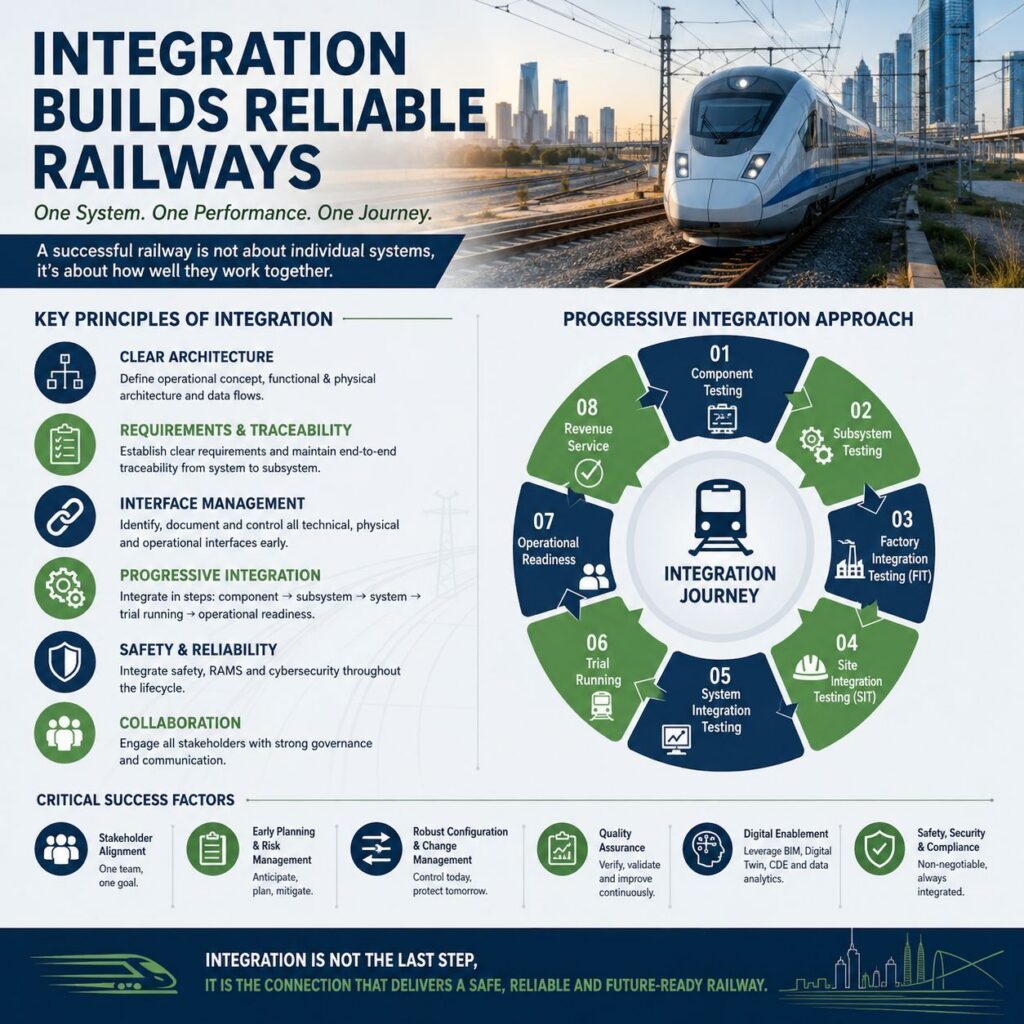
Introduction
Modern railway projects are among the most complex engineering programmes ever undertaken. A single railway corridor can involve hundreds of suppliers, thousands of interfaces, and numerous safety-critical systems working together to transport passengers safely and efficiently.
While public attention often focuses on new trains, stations, or signalling technologies, experienced railway professionals understand that many project delays and operational challenges stem from a less visible discipline: Systems Integration.
As railway systems leader Tasneem Ahmed explains, successful railways are not built by delivering individual subsystems independently—they are created by ensuring every component functions as one integrated system from the earliest stages of project development.
Why Systems Integration Matters
Railway projects consist of numerous specialist disciplines, including:
- Trackwork
- Civil Infrastructure
- Stations
- Rolling Stock
- Signalling
- Telecommunications
- SCADA
- Traction Power
- Depot Systems
- Platform Screen Doors
- Passenger Information Systems
- Automatic Fare Collection
- Operations Control Centres
- Cybersecurity
Each discipline may be designed and delivered by different organisations.
Individually, every subsystem can satisfy its contractual requirements. However, a railway cannot begin operation until these systems interact seamlessly.
This is where Systems Integration becomes essential.
Rather than treating integration as the final testing activity before commissioning, leading railway organisations now consider it a strategic programme management function beginning during concept design.
One Railway, Not Many Systems
A useful way to visualise a railway is to compare it with the human body.
Individual organs can function perfectly on their own, but without a functioning nervous system they cannot work together.
Similarly, a railway only succeeds when every subsystem exchanges information correctly, responds predictably, and supports safe operational performance.
Poor interface management between systems often leads to:
- Programme delays
- Cost overruns
- Interface conflicts
- Safety concerns
- Extensive redesign
- Operational restrictions
- Difficult commissioning
Many projects discover these issues too late—during testing or trial running—when resolving them becomes significantly more expensive.
Editorial Perspective
RailBays fully supports Tasneem Ahmed’s view that systems integration should not be regarded as the final stage of project delivery.
Experience from major railway programmes worldwide consistently demonstrates that projects investing in early systems engineering, interface management, and progressive integration generally achieve smoother commissioning, improved operational reliability, and lower whole-life costs.
As railway technology continues to evolve, systems integration will remain one of the defining competencies required for delivering next-generation railways.
About the Author
This article is an editorial adaptation based on an original LinkedIn post by Tasneem Ahmed, published with the author’s permission.
Tasneem Ahmed is an experienced Railway Systems & Programme Management Leader specialising in high-speed rail, metro systems, systems integration, signalling, telecommunications, testing & commissioning, and digital railway transformation.