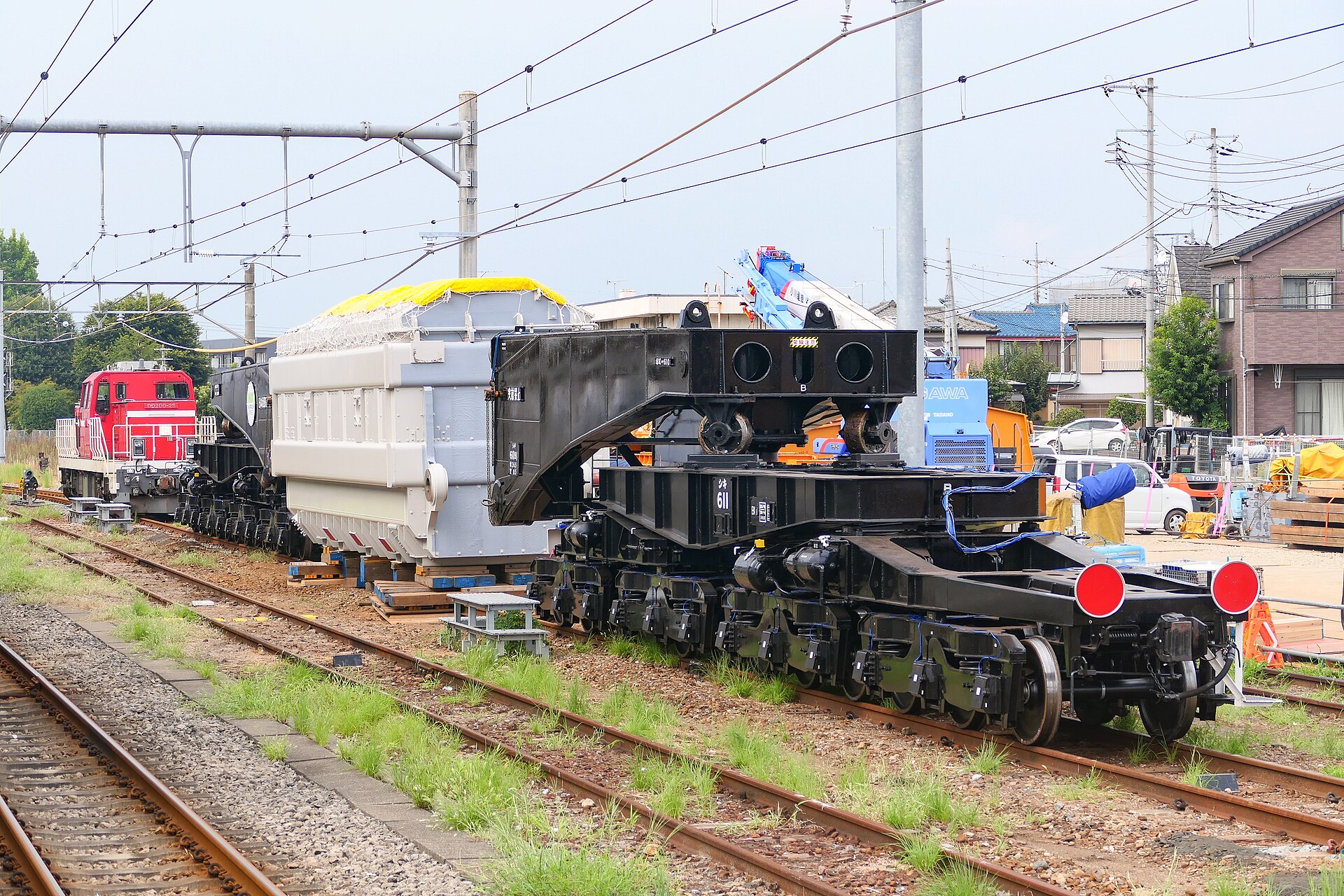
Moving a power transformer weighing well over 100 tonnes by rail presents an unusual engineering challenge. The load must not only fit within the railway’s loading and structure gauges, but its weight must also be distributed so that permissible axle loads and infrastructure constraints can be managed.
Japan’s Shiki 611 provides a striking example of how specialised railway rolling stock can solve this problem.
Operated by Nippon Express, the Shiki 611 is part of the Shiki 610 class of specialised heavy-load freight wagons used for transporting exceptionally large equipment such as power transformers.
A Different Approach to Carrying Heavy Loads
Unlike a conventional flat wagon, where cargo is placed on a loading deck, the Shiki 611 uses a specialised arrangement in which the transformer is carried between the two sections of the wagon.
The cargo therefore becomes an important part of the overall transport configuration.
This arrangement allows an exceptionally heavy component to be carried while distributing its load through multiple bogies and axles rather than concentrating it over a small section of railway infrastructure.
24 Axles for Load Distribution
One of the most distinctive characteristics of the Shiki 611 configuration is its large number of axles.
The heavy-load arrangement uses 24 axles, helping distribute the combined vehicle and cargo load over a considerably greater length of track.
Published information associated with the Shiki 610/611 identifies a maximum transformer payload of approximately 240 tonnes, although the actual permissible load for any movement will depend on the specific configuration, route and infrastructure restrictions.
This load distribution is particularly important when considering:
- Track axle-load limits
- Bridge loading
- Rail and sleeper stresses
- Turnouts and crossings
- Vertical alignment
- Structure gauge
- Platform clearances
- Overhead electrification clearances
- Route curvature
The Railway Route Becomes Part of the Engineering Problem
Transporting an exceptional load of this scale is not simply a rolling-stock exercise.
Before such a movement can take place, the proposed route must be assessed against the dimensions, weight and operating characteristics of the complete transport configuration.
Clearances through stations, structures and other constrained areas can become critical.
Track geometry and infrastructure loading also need to be considered because the vehicle behaves very differently from an ordinary freight wagon.
The result is effectively an interface-management exercise between the cargo, specialised wagon and railway infrastructure.
Still Relevant Decades After Introduction
The Shiki 611 is not a newly developed vehicle. The Shiki 610 class dates from the Japanese National Railways era.
Yet Shiki 611 continues to attract attention because specialised heavy industrial equipment still needs to be transported between manufacturing facilities, ports, substations and other infrastructure locations.
Photographs taken at Komagawa Station in September 2024, for example, document Shiki 611 configured for transformer transportation.
Its continued use illustrates how specialised railway assets can remain valuable for decades when designed for a very specific engineering purpose.
Why Rail Can Be Valuable for Transformer Transport
Large power transformers can be exceptionally difficult to transport by road.
Their dimensions and mass may require route strengthening, temporary removal of street furniture, special trailers, road closures and extensive traffic management.
Where suitable railway infrastructure and loading facilities exist, rail can provide another means of moving these exceptionally heavy components over long distances.
However, rail transportation introduces its own engineering constraints — particularly axle loads, structure gauge, bridge capacity, curvature and access to the final destination.
Specialised wagons such as the Shiki 611 demonstrate how railway engineering can overcome some of these challenges.
Engineering Beyond Passenger Trains
Railway engineering is often associated with high-speed trains, metros and passenger infrastructure.
The Shiki 611 highlights another side of the industry: specialised freight engineering designed around exceptional loads.
With its multi-axle configuration and unusual method of supporting a transformer between the wagon sections, the vehicle demonstrates how rolling stock can be engineered around the characteristics of the cargo itself.
For railway engineers, it is also a useful reminder that an exceptional-load movement must be considered as a complete system:
Cargo + Wagon + Track + Structures + Clearances + Operations
All of these elements must be compatible before the movement can safely take place.
Sources / Further Reading
NX Engineering / Nippon Express Group – Transformer and heavy equipment transportation information.
Wikimedia Commons – Shiki 611 photographs at Komagawa Station, photographed 8 September 2024. The available photographs are released under CC0 and can therefore also be considered for the Railbays featured image.
Japanese railway documentation and published technical material – Shiki 610-class heavy-load wagon configuration and capacity information.
Related Railway News