

Editorial Note
This article is an original summary and technical adaptation prepared by the RailBays Editorial Team, based on the original work of Hassanali Alikhani.
Published on RailBays with the author’s permission. The original LinkedIn article and the author’s LinkedIn profile are credited below.
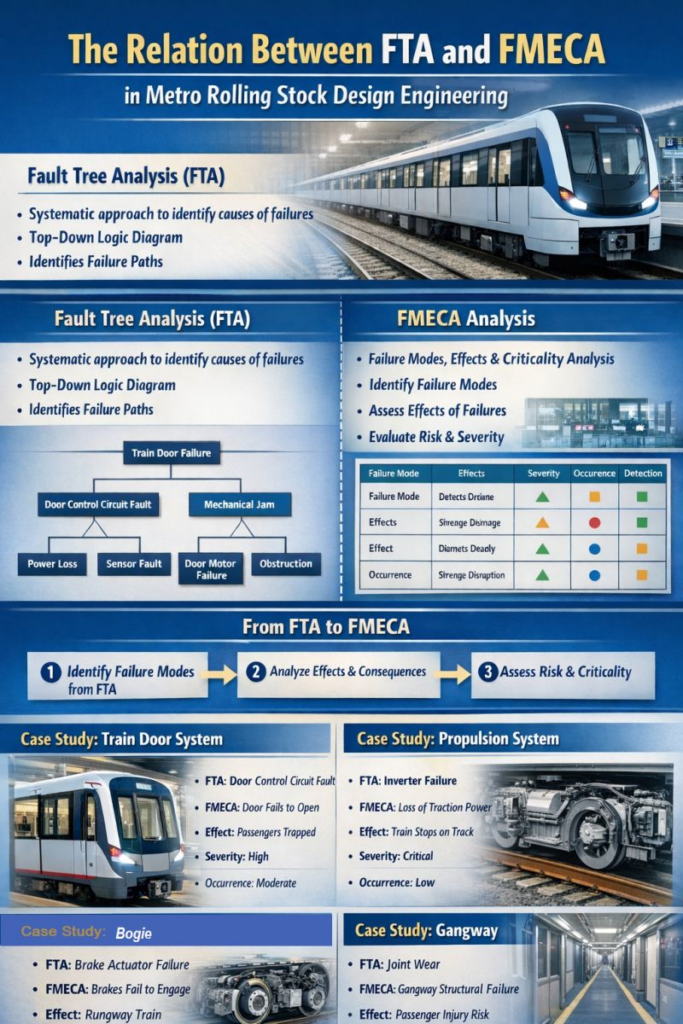
EDITORIAL SUMMARY
Introduction
Modern metro systems demand exceptionally high levels of safety, reliability and operational availability. Every component—from train doors and braking systems to traction equipment and passenger gangways—must be designed to minimise failures while ensuring safe operation throughout its service life.
To achieve this, railway engineers employ structured engineering analysis techniques during the design and verification process. Two of the most widely used methods are Fault Tree Analysis (FTA) and Failure Modes, Effects and Criticality Analysis (FMECA).
Although these techniques are often discussed separately, they are most effective when used together. FTA helps engineers understand why a system failure may occur, while FMECA evaluates what happens when individual component failures occur and how critical those failures are.
What is Fault Tree Analysis (FTA)?
Fault Tree Analysis (FTA) is a top-down analytical technique used to investigate the root causes of an undesired system event.
The analysis begins with a defined failure, known as the Top Event, and works backwards through logical relationships to identify combinations of failures that could produce that event.
Key characteristics
- Top-down methodology
- Uses logical gate diagrams (AND / OR gates)
- Identifies root causes of failures
- Supports hazard identification
- Helps improve system design and redundancy
Example
If the undesired event is:
Train door fails to operate
FTA investigates all possible causes, including:
- Door control circuit failure
- Electrical power loss
- Sensor malfunction
- Mechanical obstruction
- Door motor failure
This structured approach enables engineers to understand how multiple faults can combine to create a hazardous situation.
What is FMECA?
Failure Modes, Effects and Criticality Analysis (FMECA) is a bottom-up engineering assessment that examines every component individually.
Rather than asking why a failure occurred, FMECA asks:
- What can fail?
- What happens if it fails?
- How severe are the consequences?
- How often is the failure likely to occur?
- Can the failure be detected before it affects operations?
The objective is to prioritise engineering effort towards the failures presenting the greatest operational or safety risk.
Typical assessment parameters
- Failure Mode
- Failure Effect
- Severity
- Occurrence
- Detection
- Criticality
How FTA and FMECA Complement Each Other
Although both techniques analyse failures, they approach the problem from different perspectives.
| Fault Tree Analysis (FTA) | Failure Modes, Effects & Criticality Analysis (FMECA) |
|---|---|
| Top-down approach | Bottom-up approach |
| Starts with a system failure | Starts with individual components |
| Identifies failure causes | Identifies failure consequences |
| Uses logic diagrams | Uses structured failure tables |
| Supports hazard investigation | Supports risk prioritisation |
Together they provide a comprehensive understanding of system safety and reliability.
From FTA to FMECA
The engineering process typically follows three steps:
Step 1 – Identify Failure Modes
FTA identifies the combinations of events that may lead to system failure.
Step 2 – Analyse Effects
Each identified failure mode is then examined using FMECA to determine operational and safety impacts.
Step 3 – Assess Criticality
The failures are prioritised according to:
- Safety consequences
- Operational disruption
- Likelihood of occurrence
- Detectability
- Maintenance implications
This allows engineers to focus resources on the highest-risk issues.
Practical Railway Examples
Train Door System
FTA may identify:
- Door controller fault
- Sensor failure
- Mechanical jam
FMECA then evaluates:
- Failure effect: Door fails to open
- Operational impact: Passenger delay
- Safety impact: Passenger entrapment
- Criticality: High
Traction System
FTA identifies possible causes of inverter failure.
FMECA evaluates:
- Loss of traction power
- Train immobilisation
- Service disruption
- Safety implications
- Required maintenance response
Bogie System
Potential failure:
- Brake actuator malfunction
FMECA determines:
- Braking performance degradation
- Increased stopping distance
- Passenger safety implications
- Maintenance priority
Why These Analyses Matter
Metro operators expect rolling stock to operate safely for decades while maintaining high levels of reliability and availability.
FTA and FMECA support this objective by helping engineers:
- Improve system reliability
- Reduce safety risks
- Optimise maintenance strategies
- Enhance lifecycle performance
- Support compliance with international railway standards
Together they form an essential part of modern railway systems engineering and RAMS processes.
Conclusion
Fault Tree Analysis and Failure Modes, Effects and Criticality Analysis are complementary engineering tools rather than competing methodologies.
FTA explains how failures occur, while FMECA evaluates what happens when they occur and how significant those consequences are.
Used together, they enable railway engineers to design safer, more reliable rolling stock and support informed engineering decisions throughout the asset lifecycle.
Original Author
This technical article is based on original work by Hassanali Alikhani and is published on RailBays with the author’s permission.