
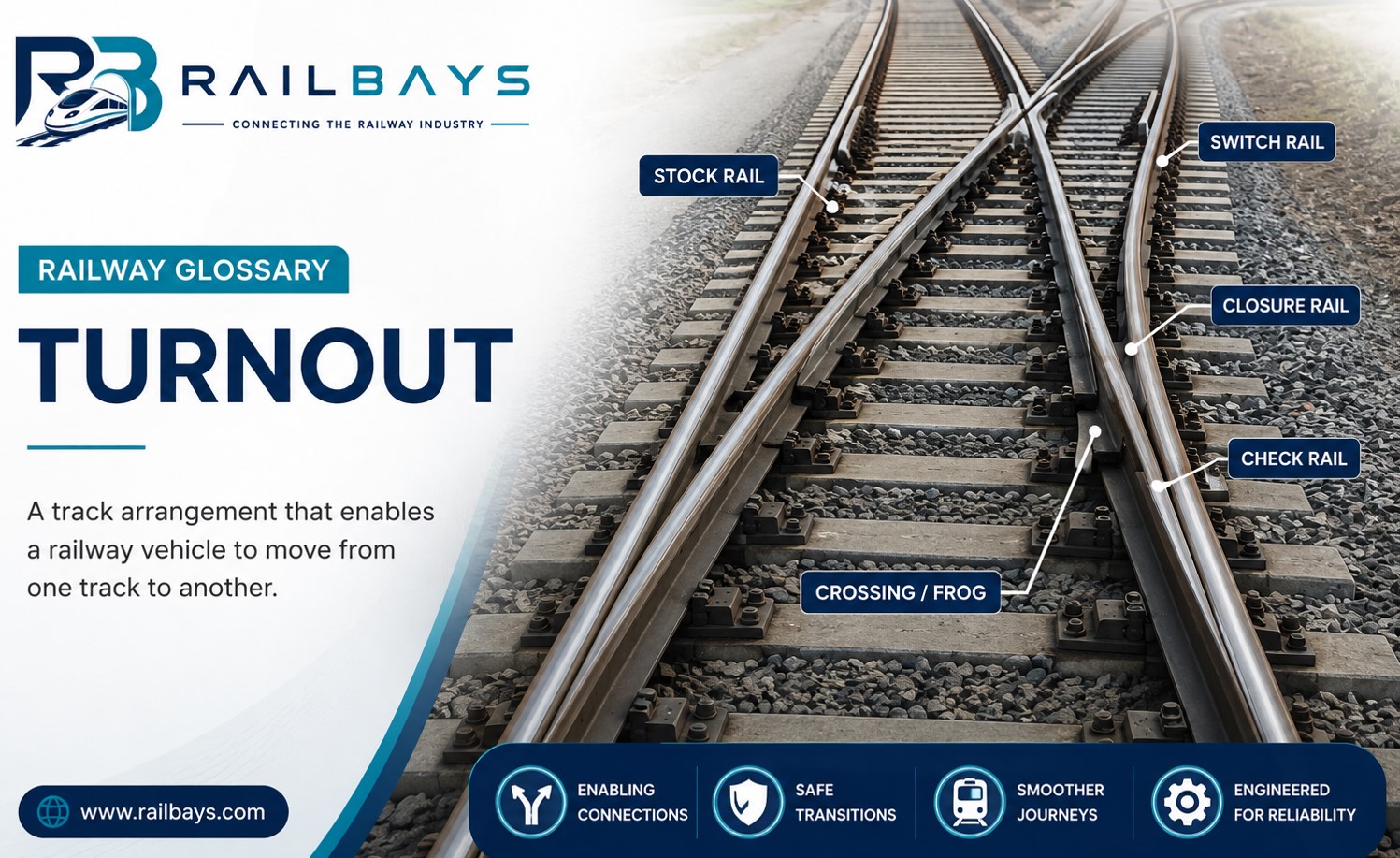
What is Turnout?
A turnout is an assembly of rails, switches, crossings, fastenings and supporting components that allows railway vehicles to transfer between two tracks.
A typical turnout consists of three principal areas:
- Switch / Points Area
The switch section contains movable switch rails positioned against the fixed stock rails. Their position determines which route the train will follow. - Closure Rail Area
Closure rails connect the switch section to the crossing and guide the wheels towards either the straight or diverging route. - Crossing / Frog Area
The crossing allows wheel flanges to pass through the intersection of the two rail routes. Check rails are normally provided to control the wheelset and maintain safe guidance through the crossing.
Turnouts may be designed for different operating speeds, axle loads, track gauges and geometries. The permissible speed through the diverging route is strongly influenced by the turnout geometry, particularly the crossing angle, switch length and curvature.
Turnouts can be operated manually or through powered point machines integrated with the railway signalling and interlocking system.
On high-speed railways, turnouts can be considerably longer than conventional turnouts and may use movable-point or swing-nose crossings to provide smoother wheel–rail interaction at higher speeds.