
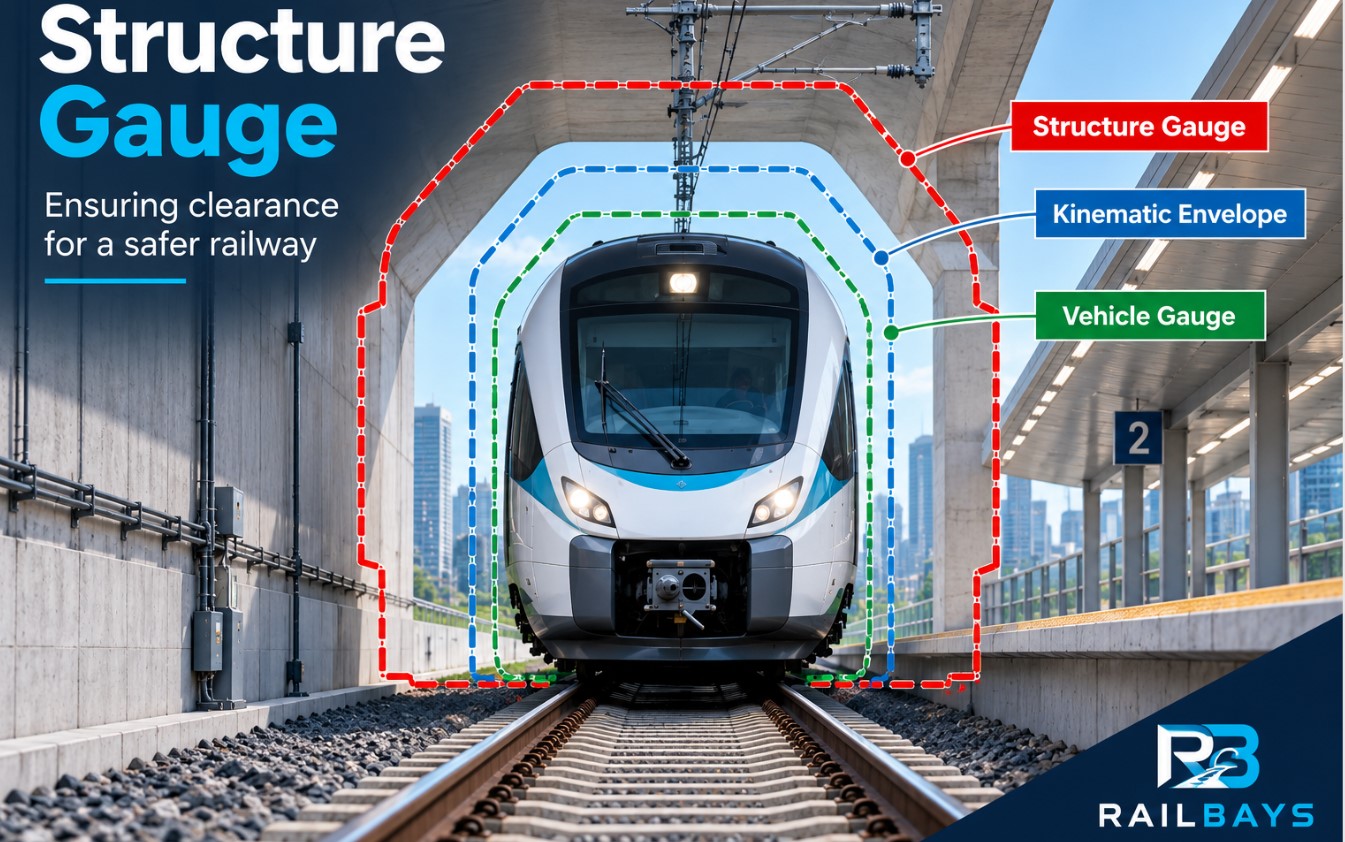
What is Structure Gauge?
Structure Gauge is the defined boundary around a railway track within which permanent infrastructure and other fixed objects should not normally intrude. It provides the required spatial clearance for trains to operate safely, taking account of the vehicle gauge, vehicle movement, track geometry, construction and maintenance tolerances, and other applicable clearance allowances.
The structure gauge is therefore larger than the basic physical dimensions of the railway vehicle. Its purpose is to ensure that structures such as tunnel linings, bridge elements, station platforms, columns, walls, signalling equipment, overhead line equipment, cable installations and other trackside assets maintain adequate clearance from passing trains.
Structure Gauge vs Vehicle Gauge
The vehicle gauge defines the dimensional envelope applicable to the railway vehicle, while the structure gauge defines the boundary that surrounding infrastructure must respect.
Between these boundaries, additional allowances may be required for factors including vehicle suspension movement, track tolerances, curvature, cant, cant deficiency, vehicle overthrow, dynamic movement, wear and maintenance tolerances.
Application in Railway Design
Structure gauge assessment is an important part of railway infrastructure design and interface management. It influences the design and positioning of:
- Tunnels and tunnel equipment
- Bridges and viaducts
- Station platforms and platform equipment
- Retaining walls
- Overhead line and traction power equipment
- Signalling and telecommunications equipment
- Walkways and evacuation routes
- Cable containment and trackside equipment
- Points, crossings and other track infrastructure
Gauge requirements should be considered from the early design stages because changes to track alignment, cant, rolling stock characteristics or equipment positions can affect the available clearance.
Structure Gauge and Kinematic Envelope
The kinematic envelope represents the space that a railway vehicle may occupy while moving, considering its permitted dynamic and geometric movements.
The structure gauge establishes the infrastructure clearance boundary around this operational envelope, with the applicable additional allowances determined by the railway system, design criteria and governing standards.
For this reason, gauge assessment is an important interface between rolling stock, track, civil structures, stations, electrification and railway systems engineering.
Why Structure Gauge Matters
Insufficient clearance can result in conflicts between rolling stock and infrastructure and can restrict future modifications or rolling-stock changes. Proper gauge management therefore contributes to safe operation, maintainability, infrastructure compatibility and long-term flexibility of the railway.
Structure gauge requirements are project- and network-specific and should always be verified against the applicable infrastructure manager’s requirements, rolling-stock characteristics and governing railway standards.