Thailand is preparing to launch procurement for the second phase of the Thai–Chinese High-Speed Railway, with eight civil works contracts for the Nakhon Ratchasima–Nong Khai section targeted for tendering by December 2026.
The latest procurement preparations mark an important step towards extending Thailand’s developing high-speed rail network northeast from Nakhon Ratchasima to Nong Khai, close to the border with Laos.
The approximately 357.12 km Phase 2 project has an approved investment of around THB 341.35 billion and will ultimately form a key part of the wider rail corridor connecting Thailand with Laos and China.
Eight Civil Works Packages Planned
The State Railway of Thailand (SRT) is progressing preparations for procurement, including the development of draft Terms of Reference (TOR), reference construction prices, tender documentation and arrangements for construction supervision.
The civil works are expected to be divided into eight contract packages, with the tender process currently targeted to commence by December 2026.
Among the sections identified in recent Thai reporting are:
- Nakhon Ratchasima–Non Sung;
- Non Sung–Bua Lai; and
- Bua Lai–Ban Haet.
Subject to the procurement process and necessary approvals, construction is currently targeted to begin during 2027, with completion targeted for approximately 2031.
357 km Extension to Nong Khai
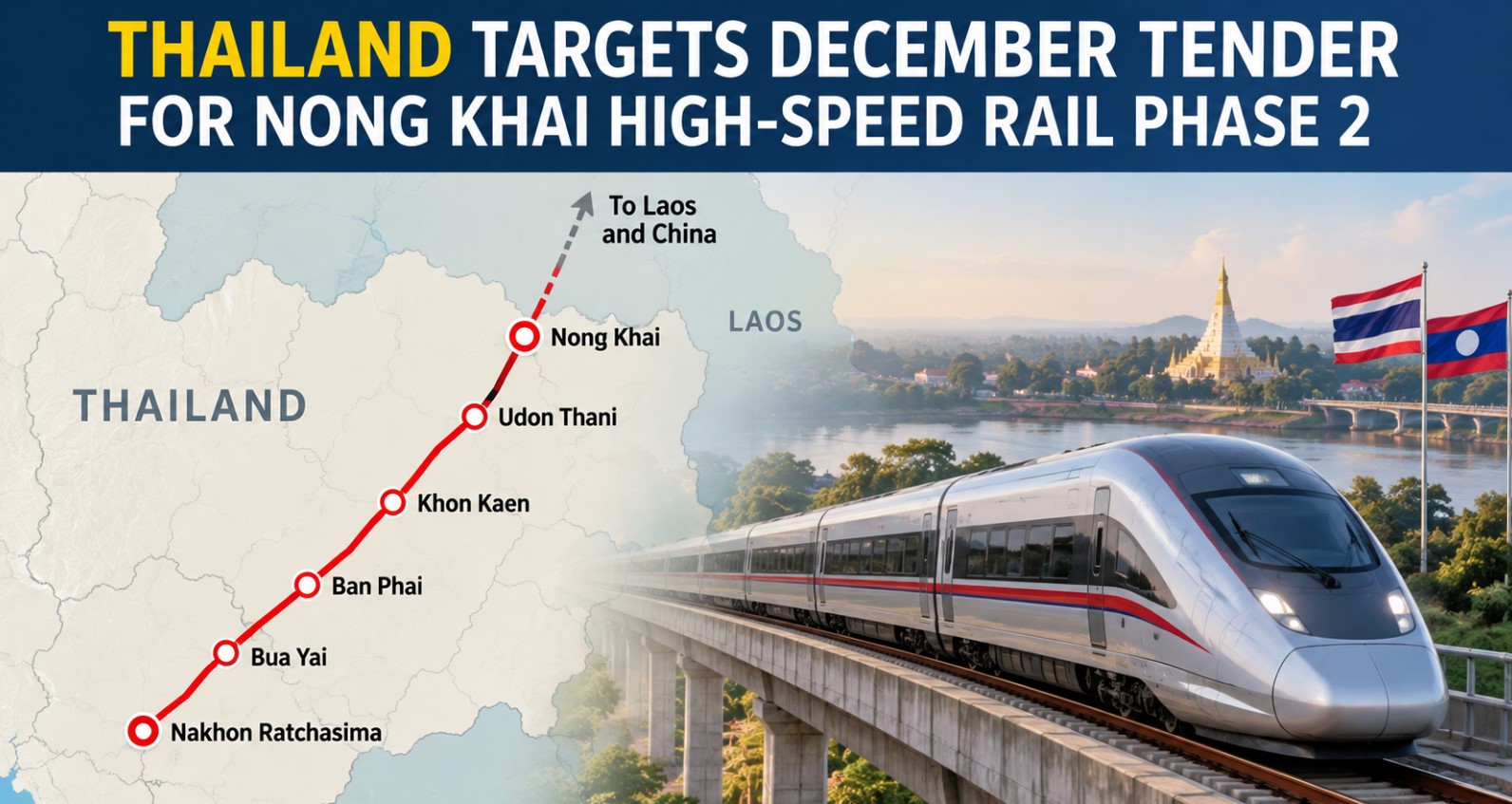
Phase 2 will extend the high-speed railway approximately 357.12 km from Nakhon Ratchasima to Nong Khai.
Five stations are planned along the route:
Bua Yai – Ban Phai – Khon Kaen – Udon Thani – Nong Khai
The project follows Phase 1, which covers the approximately 253 km Bangkok–Nakhon Ratchasima section of the Thai–Chinese High-Speed Railway.
Together, the two phases will establish a high-speed rail corridor extending from Bangkok through Nakhon Ratchasima and northeastern Thailand to Nong Khai.
Cabinet Approval Already Secured
Thailand’s Cabinet approved Phase 2 in February 2025, authorising an investment ceiling of approximately THB 341.35 billion.
The programme includes approximately THB 335.7 billion for the high-speed railway infrastructure, together with approximately THB 5.7 billion for the development of a transshipment facility at Nong Khai.
The State Railway of Thailand is responsible for implementing the project.
With Cabinet approval already secured, attention is increasingly shifting towards procurement, land acquisition, detailed implementation arrangements and construction.
Connecting Thailand, Laos and China
The strategic importance of Phase 2 extends beyond domestic passenger transport.
Reaching Nong Khai will bring Thailand’s high-speed railway network to the Lao border and support the development of a wider rail corridor linking Thailand, Laos and China.
The existing China–Laos Railway provides a rail connection between Kunming in China and Vientiane in Laos. Development of the Thai–Chinese railway is therefore an important component of Thailand’s longer-term plans for stronger regional passenger and freight connectivity.
The Nong Khai area is also expected to become increasingly important for cross-border rail logistics, reflected in the inclusion of the proposed transshipment facility within the Phase 2 investment programme.
Procurement Becomes the Next Major Milestone
The immediate focus for the railway industry will now be the planned December 2026 tendering of the eight civil works packages.
If the procurement programme proceeds as currently planned, Phase 2 could move into construction during 2027, representing another major step towards establishing a continuous high-speed rail corridor between Bangkok and Thailand’s northeastern border.
The project will also create significant opportunities across civil engineering, railway systems, stations, structures, design, construction supervision, project management and associated infrastructure services as procurement progresses.
RailBays will continue to follow the procurement and delivery of the project as further contract details become available.
Related Railway News