
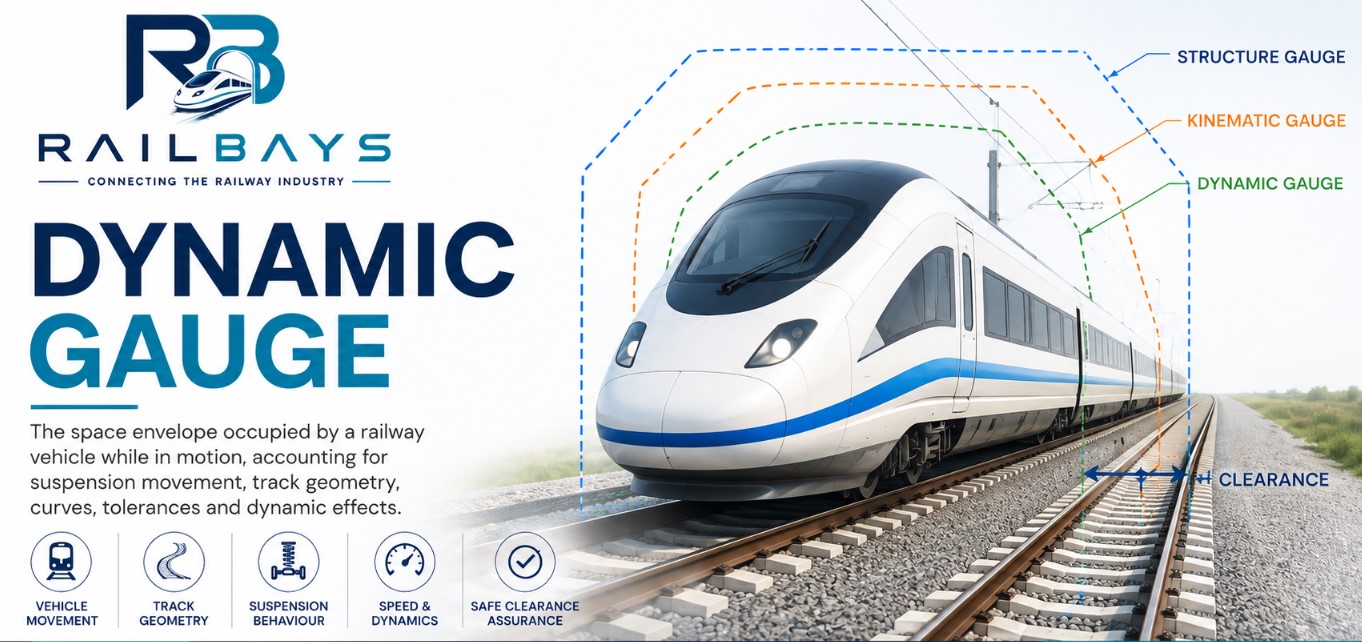
What is Dynamic Gauge?
Dynamic Gauge defines the maximum spatial envelope that a railway vehicle may occupy during operation, rather than considering only the vehicle’s stationary dimensions.
As a train moves, its position relative to the track can vary because of vehicle and infrastructure characteristics. These movements can include lateral and vertical displacement, body roll, suspension movement, wheel and track tolerances, and vehicle behaviour when negotiating curves.
Factors considered when establishing the dynamic gauge may include:
Vehicle dimensions and manufacturing tolerances
Primary and secondary suspension movement
Vehicle body roll, sway and bounce
Track gauge and track-position tolerances
Horizontal and vertical track alignment
Cant and cant deficiency
Curvature and vehicle overthrow on curves
Vehicle speed and associated dynamic behaviour
Wheel and suspension wear/tolerances
Track maintenance tolerances
The resulting envelope is used when assessing the required clearance between trains and fixed railway infrastructure such as tunnel linings, platforms, bridges, signalling equipment, overhead-line structures, cable containment and other lineside equipment.
Dynamic gauge should not be confused with the physical dimensions of the vehicle itself. It represents an operational movement envelope derived from the vehicle, track and operating conditions.
Depending on the railway standard and gauging methodology being applied, related concepts such as static gauge, kinematic gauge, structure gauge, vehicle gauge and loading gauge may have specific definitions and calculation rules.