
What is Gauge?
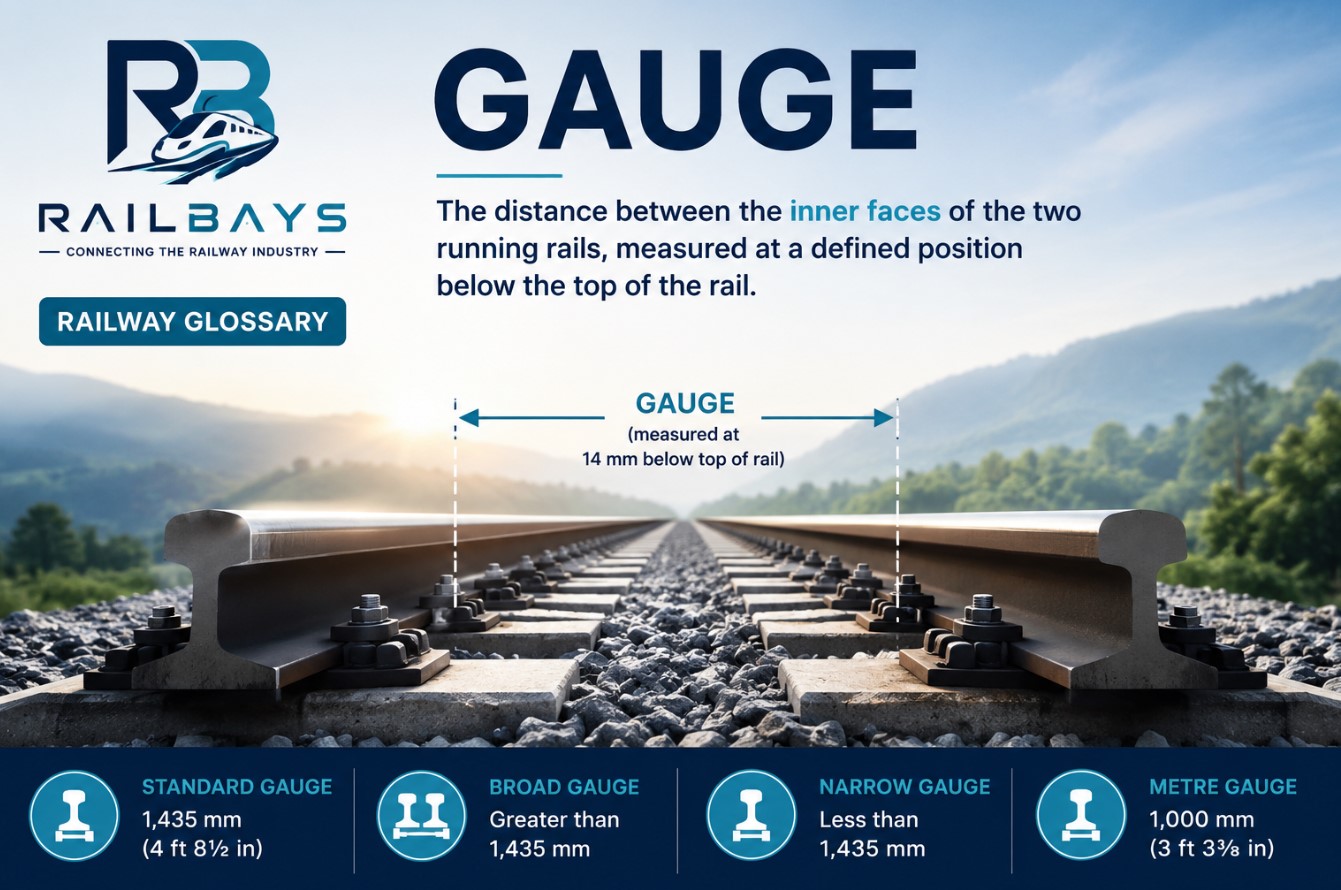
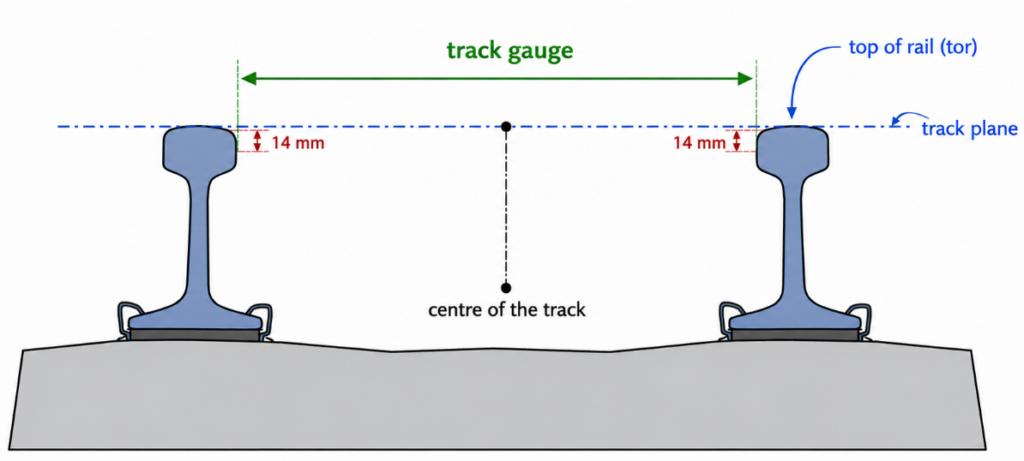
Gauge (Track Gauge) is the distance between the inner sides of the two rail heads, measured at the gauge points on the rail profiles. For conventional railway track, the gauge measurement is taken 14 mm below the top of rail (running surface).
More precisely, track gauge G is determined between points on the inner rail-head profiles at the prescribed measurement level. This is important because gauge is measured against the rail head, not the rail web.
For new, unworn rails, the measurement points are normally located consistently on the corresponding inner faces of the two rail heads. With worn rail heads, the actual contact points used to determine the minimum gauge may differ between the left and right rails due to changes in the rail-head profile.
Track gauge is one of the fundamental geometric parameters of a railway and is critical to the wheel–rail interface. It influences:
- Rolling stock and track compatibility
- Vehicle guidance and stability
- Wheel–rail interaction
- Track geometry and maintenance
- Switches and crossings
- Network interoperability
Main Track Gauge Classifications
The most widely used railway gauge worldwide is Standard Gauge – 1,435 mm (4 ft 8½ in).
Railways can generally be classified as:
- Standard Gauge: 1,435 mm
- Narrow Gauge: less than 1,435 mm, including commonly used gauges such as 1,000 mm and 1,067 mm
- Broad Gauge: greater than 1,435 mm, including gauges such as 1,520/1,524 mm, 1,600 mm, 1,668 mm and 1,676 mm
The nominal track gauge adopted by a railway determines the basic compatibility between its infrastructure and rolling stock. Where railway networks with different gauges meet, special arrangements such as passenger or freight transfer, bogie exchange, variable-gauge wheelsets or multi-gauge track may be required.
Standard Gauge
Standard Gauge = 1,435 mm (4 ft 8½ in)
Standard gauge is the most widely adopted railway gauge internationally and is extensively used for:
- High-speed rail
- Mainline passenger railways
- Freight railways
- Metro systems
- Regional railways
- Urban rail systems
Examples of networks using standard gauge include much of Europe, China, the Middle East and North America.
Its widespread adoption provides significant benefits for railway interoperability, allowing compatible rolling stock to operate between interconnected railway networks without changing wheelsets or transferring passengers and freight.
Narrow Gauge
A narrow-gauge railway has a nominal track gauge of less than 1,435 mm.
Common examples include:
- 1,067 mm – Cape Gauge
- 1,000 mm – Metre Gauge
- 914 mm – 3 ft Gauge
- 800 mm Gauge
- 762 mm – 2 ft 6 in Gauge
- 600 mm Gauge
Narrow gauge has historically been selected where lower construction cost, tighter curves or difficult terrain made a smaller railway formation advantageous.
It can be found on mountain railways, regional networks, industrial railways and some national railway systems.
However, where a narrow-gauge network interfaces with a railway of another gauge, a break of gauge may occur.
Broad Gauge
A broad-gauge railway has a nominal track gauge greater than 1,435 mm.
Examples include:
- 1,520 mm – commonly associated with networks in Russia and several neighbouring countries
- 1,524 mm – Finnish gauge
- 1,600 mm – Irish Gauge
- 1,668 mm – Iberian Gauge
- 1,676 mm – Indian Broad Gauge
Broad-gauge systems have historically been adopted for a variety of engineering, operational and national railway-development reasons.
As with narrow gauge, interoperability becomes an important consideration where broad-gauge networks meet railway systems using a different gauge.
Why is Track Gauge Important?
Track gauge is a critical parameter in the wheel–rail interface.
Correct gauge is necessary to ensure:
- Safe guidance of railway wheelsets
- Correct wheel–rail contact
- Vehicle stability
- Safe negotiation of curves
- Correct operation through switches and crossings
- Compatibility between track and rolling stock
- Control of derailment risk
- Acceptable wheel and rail wear
- Network interoperability
Gauge therefore requires close coordination between Track Engineering and Rolling Stock Engineering.
Gauge and the Wheel–Rail Interface
Track gauge cannot be considered independently from rolling stock.
The relationship between:
Track Gauge ↔ Wheel Gauge ↔ Wheel Profile ↔ Flange ↔ Rail Profile
is fundamental to safe railway operation.
The wheelset must have sufficient lateral clearance to move through the track while remaining safely guided by the rails.
This relationship becomes particularly important when assessing:
- Wheel and rail profiles
- Flange clearance
- Hunting behaviour
- Curve negotiation
- Switches and crossings
- Derailment risk
- Wheel and rail wear
Technical Note
Track gauge should not be confused with loading gauge or structure gauge. Track gauge relates specifically to the spacing of the running rails, whereas loading and structure gauges define the dimensional envelopes associated with trains and surrounding infrastructure.
The precise definition, measurement method and allowable gauge toleran