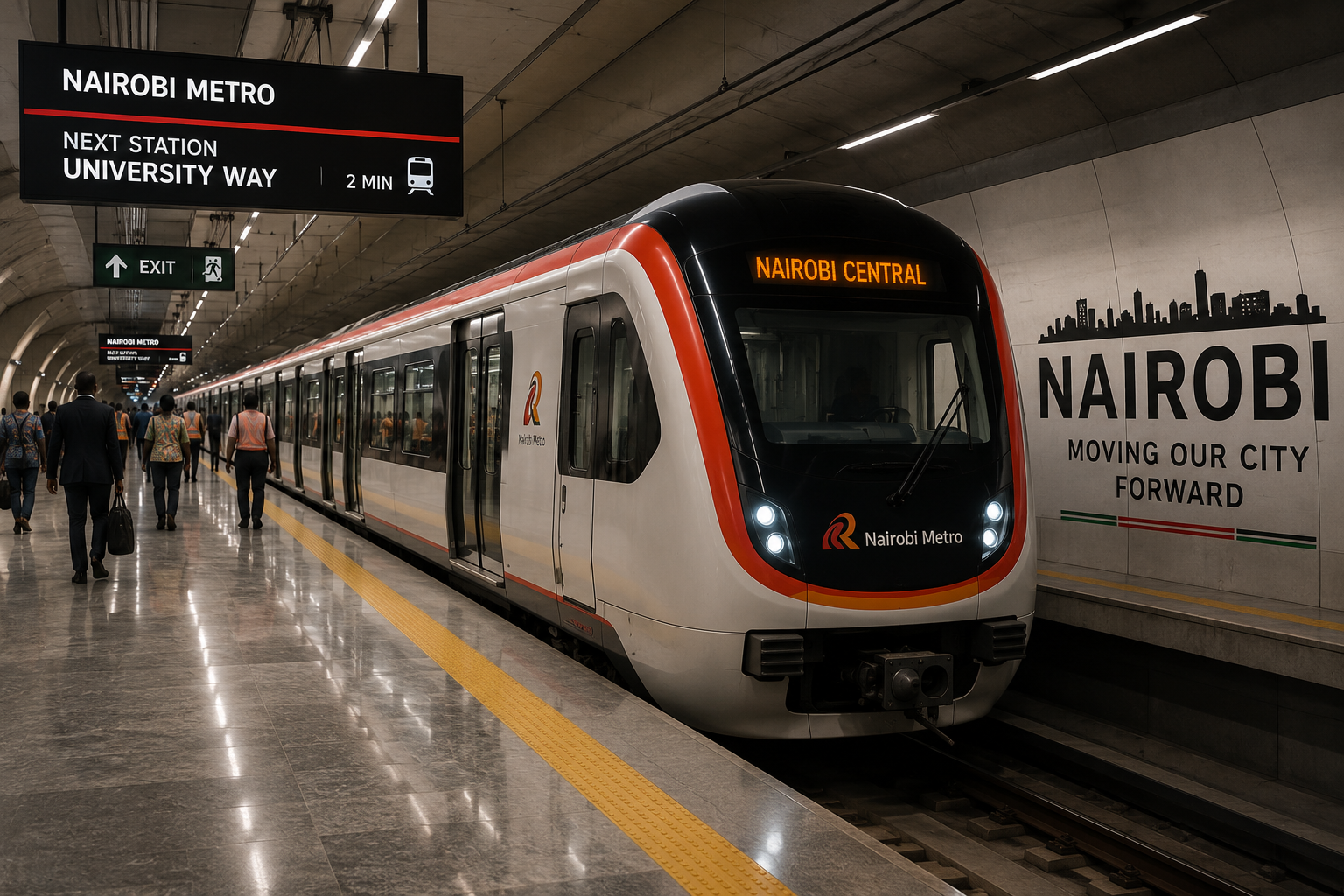
Nairobi City County has approved the implementation framework for Phase I of the Nairobi Metropolitan Mass Rapid Transit System (NMRTS), advancing plans for a major new urban rail network aimed at tackling congestion and transforming public transport in the Kenyan capital.
The approval was granted during the 90th meeting of the County Executive Committee, chaired by Nairobi Governor Johnson Sakaja. The project has been developed in technical collaboration with Kenya’s Executive Office of the President and represents an important step towards implementation of a high-capacity mass transit system for Nairobi.
Underground CBD Core and Eastlands Line
Phase I will focus on two principal elements: an underground rail core through Nairobi’s Central Business District (CBD) and the Eastlands Line, providing a high-capacity connection between the city centre and one of Nairobi’s busiest residential and commuter areas.
The underground CBD section is intended to relieve pressure on Nairobi’s congested surface transport network. Integrated interchange stations are planned to connect rapid transit services with pedestrian routes and last-mile transport.
The Eastlands corridor is expected to address heavy commuter demand between the eastern parts of Nairobi and the CBD.
Industry reports indicate that current proposals envisage a 10 km underground CBD circular line with eight stations, alongside a 13 km, predominantly elevated Eastlands Line.
Major Investment in Nairobi’s Transport Network
The wider Phase I programme has been reported at an estimated US$7.8 billion, with approximately US$6.5 billion associated with infrastructure and US$900 million allocated for rolling stock. The proposed delivery model is based on a public-private partnership, supplemented by potential non-fare revenue from station retail, advertising and transit-oriented property development.
I would phrase these figures as “reported” in the RailBays article because Nairobi City County’s official announcement confirms the Phase I approval but does not state the US$7.8 billion figure in its public news release.
Tackling Nairobi’s Congestion
The project is intended to provide an alternative to road-based commuting in a city that continues to experience severe traffic congestion.
Governor Sakaja described the approval as a commitment to delivering a modern, fast and safe public transport network, with the underground CBD core and Eastlands connection expected to help reduce travel times, improve accessibility and support Nairobi’s economic development.
The system is also planned to integrate with Nairobi’s Bus Rapid Transit (BRT) corridors through interchange stations, allowing passengers to transfer between rail, bus and other transport modes.
Phase II Already Under Planning
Planning has also started for a second phase of the NMRTS.
Phase II is expected to extend rapid transit coverage towards Westlands, Ngong Road and Lang’ata Road, improving connections for communities in areas including Ongata Rongai, Ngong and western Nairobi.
Before construction begins, Nairobi City County plans to undertake public consultations, engagement with transport stakeholders and further coordination between government agencies.
The approval of Phase I therefore represents an important milestone rather than the start of physical construction. Detailed design, financing, procurement and stakeholder processes will still need to progress before the proposed metro moves into delivery.
Related Railway News