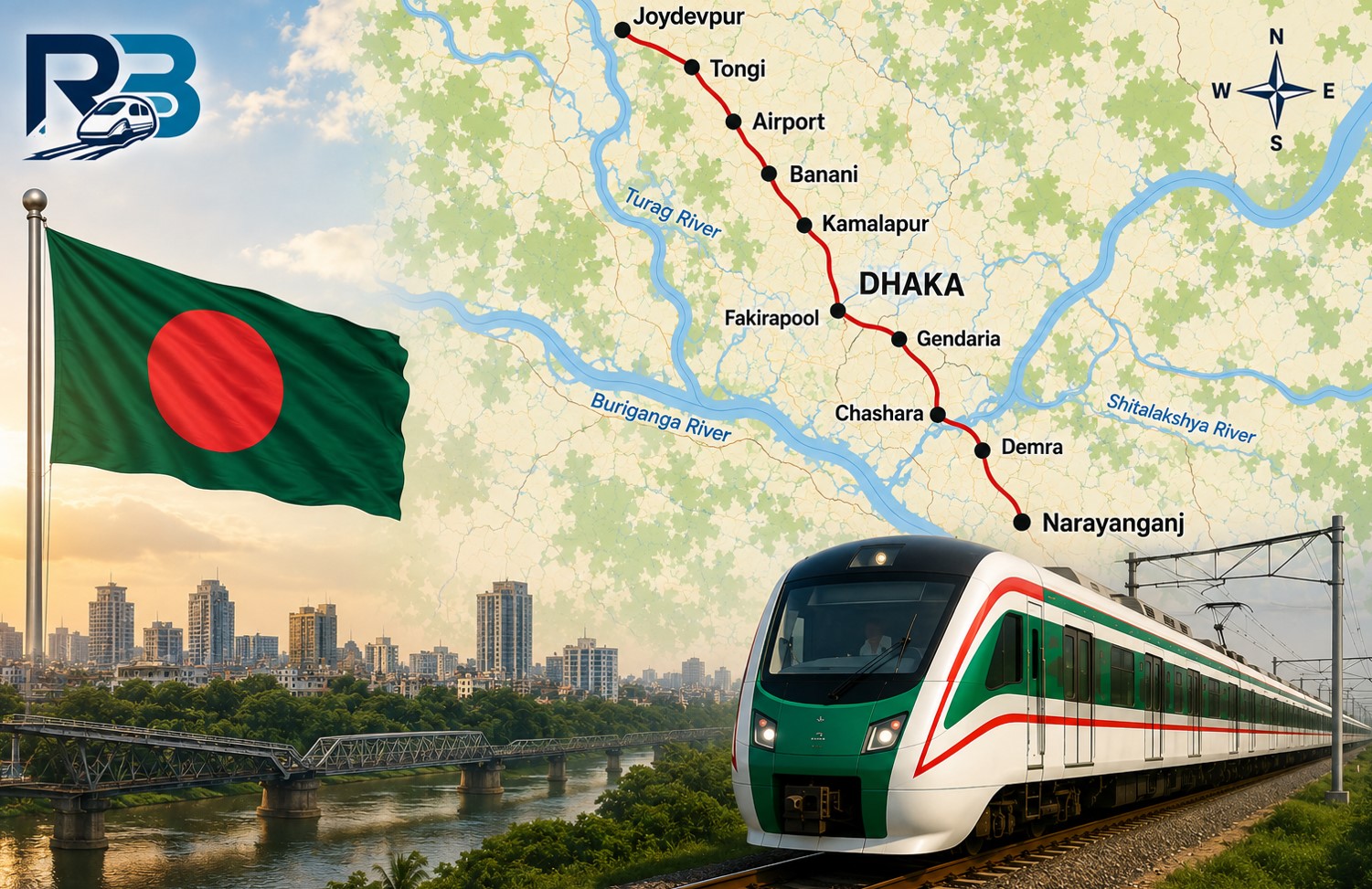
Bangladesh is moving closer to introducing electric mainline railway operations, with plans progressing to electrify and modernise the approximately 50 km Narayanganj–Dhaka–Joydebpur commuter corridor.
The proposed programme represents a significant step in the modernisation of Bangladesh Railway and could establish the country’s first electrified conventional railway corridor.
A stakeholder consultation for the proposed project has now concluded, bringing together representatives from the Ministry of Railways, Bangladesh Railway, development partners, academics and other stakeholders.
Major Capacity Expansion Planned
The project proposes the electrification and modernisation of approximately 50 km of existing railway infrastructure connecting Narayanganj, Dhaka and Joydebpur.
According to information reported following the stakeholder consultation, the programme could deliver a substantial increase in commuter railway capacity:
| Indicator | Current | Proposed |
|---|---|---|
| Corridor length | — | ~50 km |
| Daily passenger journeys | ~232,000 | More than 845,000 |
| Daily train services | ~65 | 235 |
| Peak service interval | — | 15 minutes |
This would more than triple the corridor’s stated daily passenger capacity while substantially increasing train frequency.
From Diesel to Electric Traction
A central component of the programme is the transition from diesel-powered railway operations to electric traction.
Electric rolling stock is expected to support more frequent commuter operations while reducing local air pollution, noise and carbon emissions across the Greater Dhaka metropolitan area.
The initiative is consistent with Bangladesh Railway’s wider strategy to investigate the transition from diesel-electric traction towards railway electrification.
Earlier feasibility and detailed-design work commissioned by Bangladesh Railway examined electric traction, including overhead catenary systems and traction substations, across the wider Narayanganj–Dhaka–Chattogram and Tongi–Joydebpur railway corridors. Bangladesh Railway identified objectives including reducing operating and locomotive-maintenance costs, improving average speeds, reducing environmental pollution and improving compatibility with the Trans-Asian Railway Network.
International Financing Support
The Narayanganj–Dhaka–Joydebpur initiative is being supported jointly by the European Union, European Investment Bank (EIB) and Asian Development Bank (ADB) under the EU’s Global Gateway initiative, according to the information reported following the consultation.
The involvement of international development institutions could help support not only railway electrification but the broader modernisation required to operate substantially higher-frequency commuter services.
More Than an Electrification Project
From a railway engineering perspective, moving from approximately 65 to 235 train services per day would make this considerably more than an overhead-electrification programme.
Achieving the proposed operating intensity is likely to require coordinated development across multiple railway disciplines, potentially including:
- Overhead Contact System (OCS/OLE) and traction power substations
- Electric rolling stock
- Signalling and train-control systems
- Telecommunications and operational control
- Track and turnout infrastructure
- Stations and passenger facilities
- Depot and maintenance facilities
- Power supply and distribution
- Earthing and bonding
- Operations and timetable planning
The precise scope and configuration of these systems will depend on the final project design.
Part of a Longer-Term Electrification Strategy
Bangladesh Railway has been examining railway electrification for several years.
Its earlier feasibility programme covered approximately 348.16 km, comprising the 336.89 km Narayanganj–Dhaka–Chattogram corridor and the 11.27 km Tongi–Joydebpur section, with 70 stations identified within the study scope.
The Ministry of Railways also recorded consideration of a Development Project Proposal specifically titled “Implementation of Electric Traction along Narayanganj–Dhaka–Joydebpur section of Bangladesh Railway” in December 2025.
The current 50 km commuter-corridor proposal therefore appears to represent a focused implementation step within Bangladesh Railway’s broader ambitions for electric traction.
A Potential Turning Point for Bangladesh Railway
If implemented as proposed, the Narayanganj–Dhaka–Joydebpur project could represent an important technological transition for Bangladesh’s conventional railway network.
For passengers, the most visible change would be more frequent services and significantly increased capacity. For Bangladesh Railway, however, the programme would introduce a new railway operating environment requiring the integration of electric traction, rolling stock, signalling, power, maintenance and operational-control systems.
The project could also provide an important reference for future electrification of other high-demand railway corridors in Bangladesh.
Penang Mutiara Line LRT
View the full RailBays project profile, key facts, procurement activity and awarded contracts.
View Rail Project →Related Railway News