
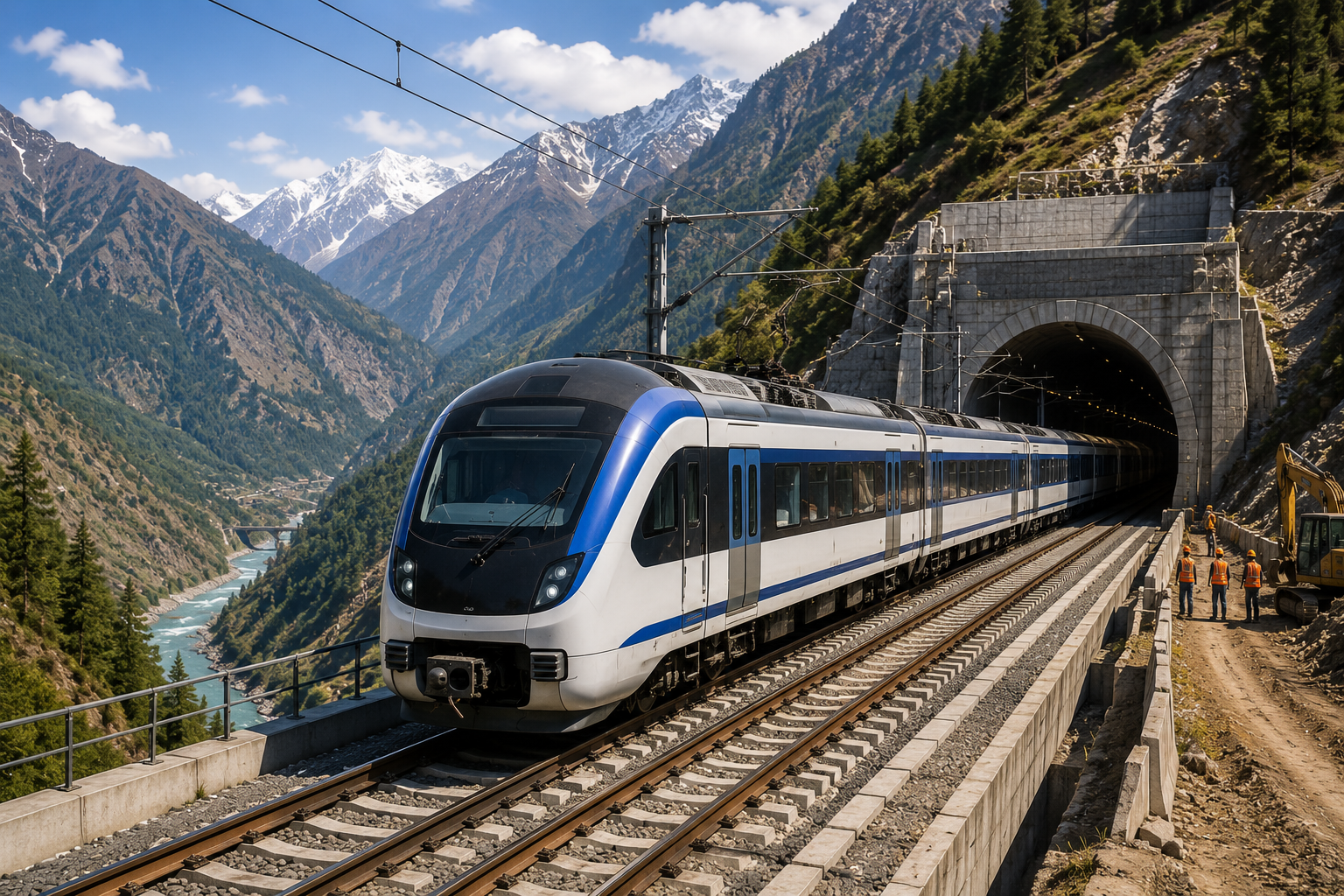
India is reportedly preparing a major programme of railway infrastructure investment along areas bordering China, Pakistan and Bangladesh, as the country continues to strengthen rail connectivity in strategically important regions.
The proposed programme is reported to involve approximately ₹45,000 crore (around US$5 billion) of railway investment, covering new and upgraded infrastructure intended to improve connectivity and network capacity in border regions.
The initiative would form part of India’s wider programme to expand railway access into remote and strategically significant areas, particularly across the country’s northern and north-eastern regions.
Focus on Strategic Rail Connectivity
India shares extensive land borders with China, Pakistan and Bangladesh, including mountainous and geographically challenging regions where transport infrastructure can be difficult to develop.
Rail investment in these areas serves both civilian and strategic requirements. Improved lines can provide better passenger and freight connections for communities while also increasing the resilience and capacity of the national transport network.
The Government of India has already confirmed substantial railway investment across the North-East.
In March 2026, the Ministry of Railways reported major ongoing projects including the 111 km Jiribam–Imphal new line, valued at ₹21,886 crore, and the 82 km Dimapur–Kohima line, valued at ₹15,230 crore. Other projects include doubling works between New Bongaigaon, Goalpara and Guwahati and between Lumding, Furkating and Tinsukia.
New Railway Surveys Underway
The government’s railway expansion programme is also looking beyond projects currently under construction.
According to the Ministry of Railways, 45 surveys covering approximately 3,590 km of railway infrastructure within the Northeast Frontier Railway area have been sanctioned in recent years. These comprise 24 new-line surveys and 21 doubling surveys.
Such surveys are an early but important stage in railway development, allowing potential alignments, engineering requirements, costs and demand to be assessed before projects progress towards detailed approval.
Connecting More State Capitals
A major objective of India’s railway investment in the North-East has been extending the national network to state capitals and previously underserved regions.
The 51.38 km Bhairabi–Sairang railway in Mizoram, commissioned in September 2025, provided rail connectivity to Aizawl. The technically challenging project incorporates 45 tunnels, 55 major bridges and 88 minor bridges.
Planning is continuing beyond Sairang. A Final Location Survey has been sanctioned for the proposed 223 km Sairang–Hbichhuah new railway, allowing a Detailed Project Report to be prepared.
The development demonstrates the engineering challenges associated with extending India’s railway network through mountainous terrain close to international borders.
Wider Modernisation of Indian Railways
The strategic infrastructure programme comes amid extensive investment across the wider Indian Railways network.
The Ministry of Railways says modernisation is focused on improving safety, capacity, speed, operational efficiency, passenger facilities and the adoption of new technologies.
Investment is taking place across track and traction infrastructure, signalling, digital communications, rolling stock and stations.
In July 2026, Prime Minister Narendra Modi inaugurated another 75 stations redeveloped under the Amrit Bharat Station Scheme, representing investment of approximately ₹1,570 crore. An earlier group of 103 redeveloped stations was inaugurated in May 2025.
The Ministry has also allocated ₹11,972 crore for passenger amenity and station development works during the 2026–27 financial year, with ₹4,633 crore spent by the end of June 2026.
Rail Infrastructure Takes on Growing Strategic Importance
The reported ₹45,000 crore border railway programme would therefore build upon a much larger programme already underway across India’s railway network.
For the country’s border regions, however, the significance extends beyond increasing passenger capacity. New lines, doubling projects, upgraded signalling and improved railway infrastructure can strengthen regional accessibility, economic development and network resilience while providing additional transport capacity in strategically important areas.
Further details—including individual projects, routes, implementation schedules and the final investment allocation—will become clearer if and when the programme receives formal government approval.
Related Railway News